
Benchmarking for procurement maturity: using your data to negotiate better terms
Procurement maturity benchmarking uses real-world post-signature contract analysis to improve negotiations, enforce compliance, and prevent revenue loss. Most organizations miss out on savings and control because key data is scattered or locked in silos. This article explains the value of post-signature visibility for procurement maturity, the business impact of gaps, and how Zefort offers compliance-driven teams actionable pricing intelligence and contract control.
Key topics covered include:
- What procurement maturity benchmarking is and why it works
- Data-backed impact of poor post-signature control
- How gaps appear in daily operations
- What compliance-focused teams gain from better benchmarking
- How Zefort enables smarter, safer spend analysis and negotiation
What is procurement maturity benchmarking?
Procurement maturity benchmarking is the process of using past contract data to measure how well your team captures value and maintains compliance over time. It looks at renewal rates, clause enforcement, historical pricing, and regulatory performance.
This practice supports every key function:
- Legal: Finds gaps in contract terms and templates
- Procurement: Quantifies negotiation leverage and supplier performance
- Finance: Tracks realized savings versus planned value
- Compliance: Measures adherence to frameworks like GDPR, DORA, or NIS2
- Legal operations: Identifies workflow bottlenecks
The main obstacle is that most firms lose post-signature oversight. Contracts become static files, making data nearly impossible to search or analyze at scale.
The business impact of limited post-signature data
Limited visibility into contracts after signing leads to significant and measurable value leakage. According to World Commerce & Contracting (WorldCC), organizations lose 8.6–9.2% of contract value on average due to missed obligations, unmanaged renewals, and weak post-signature governance.
Typical impacts include:
- Missed renewals – contracts auto-renew on unfavourable terms when renewal dates and clauses are not actively tracked.
- Compliance risk – lack of post-signature oversight increases exposure to regulatory breaches and contractual non-compliance.
- High manual effort – fragmented tools force teams to manually track obligations, clauses, and deadlines, driving unnecessary operational cost.
- Weaker negotiations – without historical contract data and benchmarks, organizations enter renewals with reduced leverage.
Research also indicates that the majority of enterprise contracts remain unmanaged after signing, making post-signature data one of the largest untapped sources of commercial and risk value.
How procurement data gaps show up in real organizations
In daily operations, gaps in procurement maturity and spend analysis surface when:
- Documents are scattered in shared drives, making it slow to gather renewal or pricing history for vendor negotiation
- Obligations hide in email threads, resulting in missed rebates, poor compliance, or surprise auto-renewals
- Spreadsheets for contract tracking lack version control, creating errors and audit headaches
- Legacy CLMs focus on pre-signature workflows, leaving post-execution data unstructured and nearly unusable for reporting or benchmarking
As a result, teams enter renewals blind, accept worse terms, and struggle to enforce contract value. Finance misses savings; compliance risks, fines, and urgent fire drills during audits.
Why compliance-driven teams need post-signature control
In regulated industries, post-signature contract control is essential for compliance and audit readiness. Regulations such as the GDPR and the EU’s Digital Operational Resilience Act (DORA) require organizations to demonstrate contract traceability, clause enforcement, and renewal history on demand. Without structured post-signature data, audits slow down, compliance risks increase, and large-scale reviews triggered by M&A or regulatory change become costly and error-prone.
Under GDPR alone, non-compliance can result in fines of up to 4% of global annual revenue. Research from World Commerce & Contracting further shows that organizations frequently miss contractual obligations without benchmarking and active tracking, while mature teams use post-signature data to strengthen negotiations, optimize contract terms, and prove compliance when required.
Read next: Procurement contract management software: The ultimate guide
How Zefort enables smarter benchmarking
Zefort is designed for teams who value post-signature control and compliance above fast drafting. Key features for strategic sourcing, finance, and legal teams include:
- AI-powered metadata extraction: Auto-tags key dates, parties, notice periods, and clauses for fast queries
- Automated obligation alerts: Track milestones and flag risks across large portfolios, reducing leakage and missed deadlines
- Immutable audit trails: Complete history for every contract action — supporting audits, DORA, and NIS2 compliance
- Centralized repository: Unified, secure search over all agreements surfaces pricing trends and renewal patterns in seconds
Zefort suits compliance-driven organizations managing 1,000+ contracts, where structured data and audit-readiness trump pre-signature automation.
🔑 Key takeaways
- Procurement maturity benchmarking turns post-signature contract data into a measurable source of savings, compliance, and negotiation leverage.
- Most organizations lose 8–9% of contract value because post-signature data is fragmented, unstructured, or unmanaged.
- Gaps in post-signature control show up daily as missed renewals, manual tracking, audit delays, and weaker supplier negotiations.
- In regulated industries, post-signature visibility is essential to meet GDPR, DORA, and NIS2 requirements and respond to audits or regulatory change on demand.
- Mature procurement teams use historical contract data to benchmark pricing, enforce obligations, and prove compliance — instead of relying on spreadsheets or email trails.
- Zefort enables compliance-driven teams to centralize contracts, extract structured data automatically, and benchmark performance across large contract portfolios with confidence.
FAQs
Post-signature data enables organizations to analyze contract performance, identify missed renewals, enforce clauses, and measure compliance over time. This structured visibility allows teams to benchmark vendor terms, reduce revenue leakage, respond to audits quickly, and secure better negotiation outcomes.
Unmanaged contract data can lead to 9% revenue leakage, missed renewals worth millions annually, compliance fines, and increased manual effort—up to 40 hours per contract. Teams may struggle during audits and enter vendor negotiations without key details, resulting in weaker terms and higher risk exposure.
Data gaps show up as scattered documents in shared drives, obligations lost in emails, and error-prone spreadsheets. Legacy systems often track only pre-signature processes, leaving critical information unstructured and hard to access for reporting, benchmarking, or compliance checks.
Post-signature control helps regulated organizations meet audit and regulatory demands, such as GDPR or DORA requirements. It supports full traceability of contract actions, enables fast proof of clause enforcement, and reduces exposure to large penalties stemming from missed or untracked obligations.
Zefort extracts key metadata from contracts using AI, automates alerts for renewals and obligations, and provides a centralized, searchable repository. These capabilities reduce manual tracking, minimize risk, and support benchmarking for improved negotiation outcomes and audit readiness, especially for organizations managing large contract volumes.
Unlike many CLM tools focused on pre-signature processes or legal workflows, Zefort prioritizes post-signature control, compliance, and data accessibility. It is especially effective for teams with high regulatory requirements and large contract portfolios needing ongoing benchmarking and traceable audit trails.
Organizations using structured, post-signature benchmarking often achieve 10–15% better negotiation terms and reduce manual tracking time by up to 70%. They also avoid significant losses, with unmanaged contracts typically causing an average 9% value leakage each year.
Compare European CLM leaders
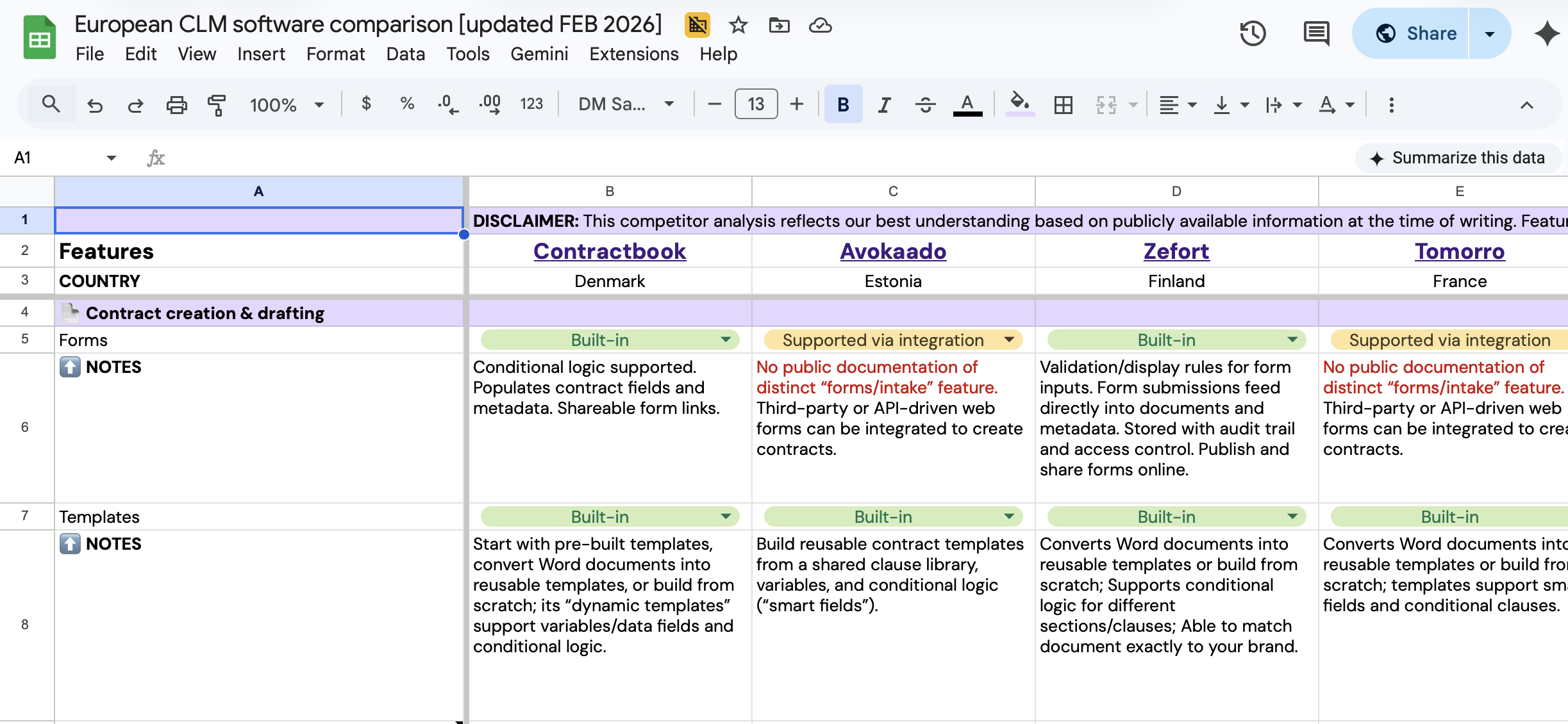
Get a comprehensive breakdown of the top CLM solutions in one spreadsheet.

Compare European CLM leaders
Get a comprehensive breakdown of the top CLM solutions in one spreadsheet.