Contract management for legal teams: how to save time without losing control
Legal teams operate in environments marked by complex procedures, strict regulatory demands, and large volumes of contracts. The need for efficient contract management is self-evident. This article explores practical strategies and tools that help legal teams optimize their contract management process without compromising oversight or quality.
In this article, we’ll explore:
- Practical strategies to speed up contract processes
- The role of contract lifecycle management (CLM) software
- How legal teams can balance efficiency and compliance in daily operations
- Why data readiness is becoming a critical foundation for modern legal work
Time-saving strategies for contract management
Legal teams can adopt several practical strategies to improve efficiency without losing oversight:
- Define clear roles and responsibilities: Assign ownership for contract drafting, review, and approvals. This prevents bottlenecks and ensures accountability.
- Use standard templates: Standardized contract templates reduce drafting time, minimize errors, and help maintain consistency across agreements.
- Centralize contract storage: A centralized repository allows quick access to contracts, ensures version control, and reduces the risk of lost documents.
- Implement automation for repetitive tasks: Automated reminders for renewals, approvals, and compliance deadlines save time and reduce human error.
- Track key dates and obligations: Maintain visibility over expiration dates, milestones, and obligations to avoid missed deadlines or compliance issues.
Leveraging contract lifecycle management tools
Contract lifecycle management (CLM) tools help legal teams enhance processes rather than replace them. Features such as automated workflows, reminders, and central, searchable contract repositories make it easier to manage large volumes of contracts more efficiently.
With a CLM platform, legal teams can:
- Automate repetitive tasks such as data entry and deadline tracking
- Maintain an organized, searchable repository of contracts
- Track obligations, approvals, and renewals in real time
- Ensure compliance with internal policies and external regulations
- Provide reports and dashboards for transparency and decision-making
See also: 10 best contract management software in 2026
Maintaining control while saving time
Efficiency does not have to come at the cost of control. By combining best practices with a CLM platform, legal teams can:
- Speed up contract approvals without bypassing necessary checks
- Ensure consistent application of legal standards across all contracts
- Reduce manual errors while keeping full visibility of contract histories
- Focus on higher-value tasks, such as negotiating complex agreements or assessing risk
Using CLM tools also supports collaboration with other departments, such as procurement or finance, while keeping the legal team in control of compliance and risk management.
The rising importance of legal data readiness
Before workflows can be optimized or automation fully leveraged, legal teams must ensure the underlying data supporting their contracts is well-organized, structured, and accessible. Legal data readiness refers to the practice of transforming scattered contract information into clean, consistent, machine-readable data that can fuel automation, analytics, and AI-driven tools.
Many legal teams still operate with fragmented data, contracts stored across multiple locations, inconsistent naming conventions, or missing metadata. This makes it difficult to locate information quickly, extract insights, or introduce meaningful automation.
Strengthening data readiness helps teams:
-
Build a reliable source of truth for contract terms, obligations, and key dates
-
Reduce the time spent searching for documents or manually interpreting information
-
Support compliance by ensuring data is complete, traceable, and audit-friendly
-
Prepare for emerging AI tools that require structured, high-quality data to generate accurate results
-
Enhance collaboration with other departments by making information more shareable and understandable
By ensuring legal data is clean and well-managed, contract-management improvements become far more effective—and future technologies can be adopted with significantly less friction.
If you’re looking to build AI readiness in your legal team, watch this on-demand webinar to discover how to turn your organization’s data into a foundation for AI.
Best practices for legal teams
- Conduct regular audits of contracts to ensure compliance and alignment with organizational policies
- Foster collaboration by allowing team members to contribute to contract review and approval workflows
- Continuously review and update processes and templates to reflect evolving business needs and regulatory requirements
- Leverage analytics from CLM tools to identify bottlenecks and improve efficiency
- Strengthen data hygiene by ensuring contracts are properly indexed, tagged, and enriched with accurate metadata to support faster searchability and better automation
🔑 Key takeaways
- Time-saving strategies include using templates, defining roles, centralizing storage, and automating repetitive tasks.
- CLM software provides automation, reminders, centralized storage, and compliance monitoring to enhance workflows.
- Strong legal data readiness amplifies the impact of CLM and process improvements, enabling better insights, improved compliance, and future AI adoption.
- Combining best practices with technology allows legal teams to focus on high-value activities without compromising oversight.
Legal teams that adopt these strategies and tools can manage contracts efficiently, meet compliance standards, and support broader business objectives.
FAQs
A clear warning sign is when stakeholders regularly complain about slow turnaround times, missing documents, or unclear responsibilities. Repeated delays or confusion typically point to underlying process issues.
Even small teams gain significant advantages by reducing manual tasks and centralizing documents. This allows them to operate with the efficiency of larger teams without adding headcount.
High-volume, lower-risk agreements, such as NDAs, vendor contracts, or routine renewals, tend to benefit the most since they involve repetitive steps that are easy to automate.
Clear communication, simple workflows, and training sessions help create alignment. Demonstrating how improved processes reduce delays for other teams also increases adoption.
Key aspects include ease of use, integration with existing tools, scalability, reporting capabilities, and flexibility in customizing workflows to match internal policies.
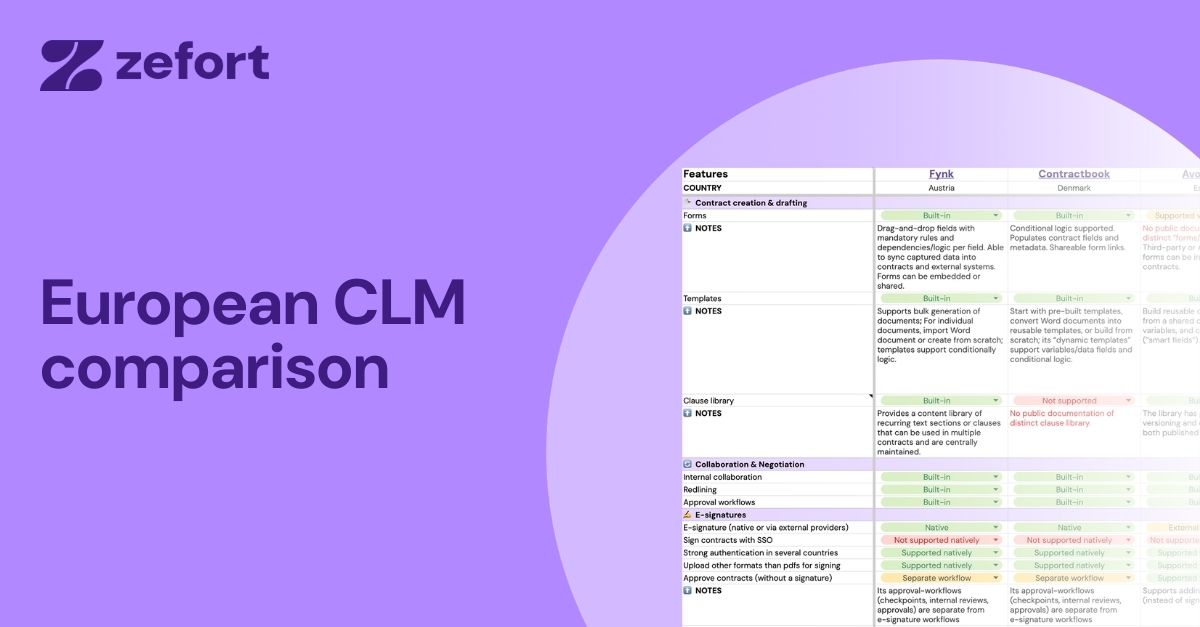
Compare European CLM leaders
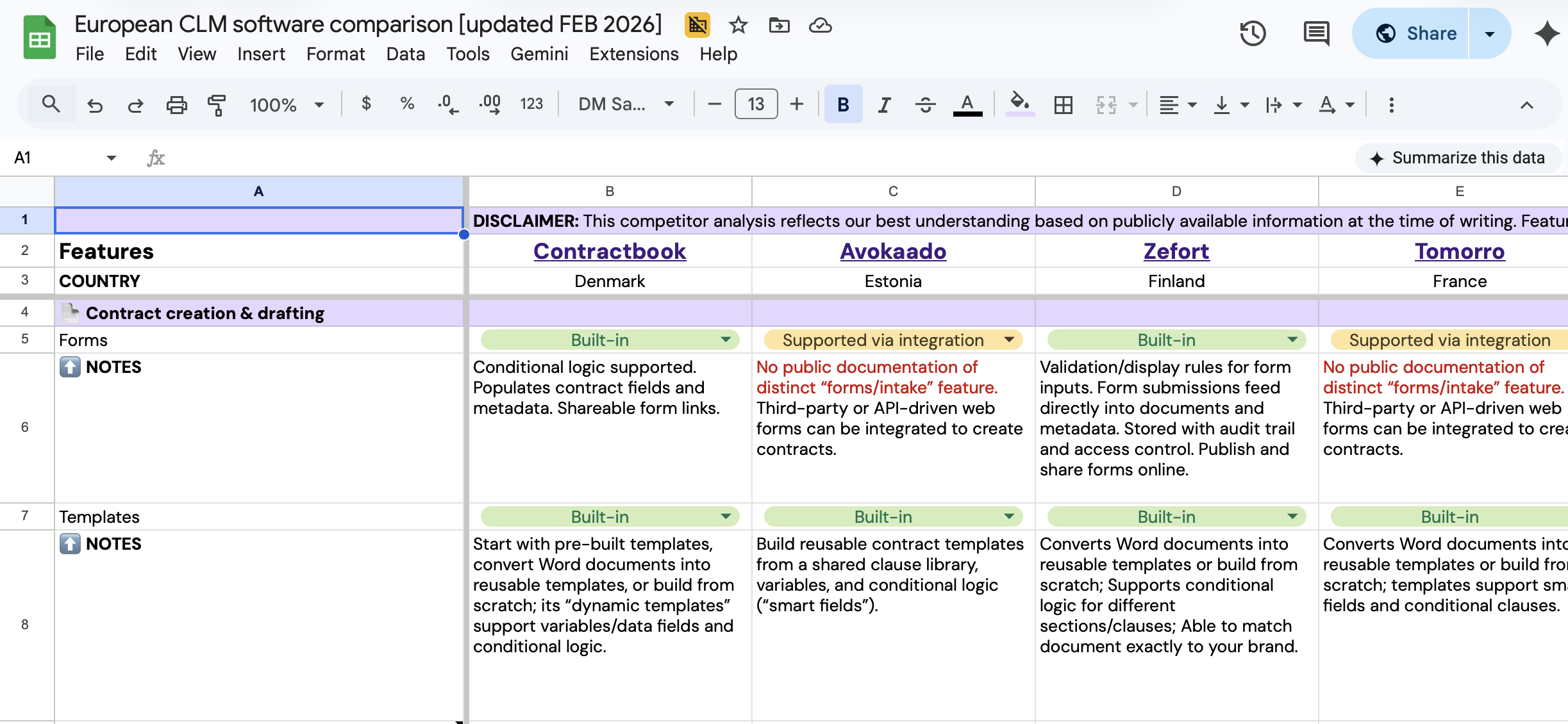
Get a comprehensive breakdown of the top CLM solutions in one spreadsheet.

Compare European CLM leaders
Get a comprehensive breakdown of the top CLM solutions in one spreadsheet.