Contract management software reviews: how to look beyond ratings
Contract management software reviews play an important role when organizations start evaluating CLM tools. Reviews are often the first external source teams consult before demos, comparisons, or internal discussions begin.
However, most contract management software reviews are not written with long-term contract ownership, legal accountability, or compliance requirements in mind. Ratings and feature summaries can be useful, but they rarely reflect how a tool performs once it becomes part of everyday contract work.
This article explains how to use contract management software reviews effectively – what they reveal, where they fall short, and how to go beyond them when selecting a solution for legal or compliance teams.
Why contract management software testimonials matter when choosing a CLM tool
Reviews provide early signals that are difficult to get elsewhere. They highlight usability, adoption challenges, onboarding effort, and common frustrations that are not always visible in demos or product websites.
For teams selecting software for legal or compliance use, reviews can also indicate whether a tool genuinely supports structured contract ownership or simply shifts manual work elsewhere.
At the same time, reviews should not be treated as proof. They are best used to form hypotheses and questions, not final conclusions.
Which contract management software reviews can you trust
The most valuable contract management software reviews share a few traits:
- The reviewer’s role and responsibilities are clearly stated
- The company context is explained (size, industry, contract volume)
- The review reflects ongoing use, not just first impressions
Star ratings alone offer limited insight. What matters is how reviewers describe daily workflows, exceptions, and limitations – especially when the software is used by legal or compliance teams over time.
Limitations of G2 and Capterra contract management software reviews
G2 and Capterra are often the first stop when researching CLM tools. They are helpful, but structurally incomplete.
Common limitations include:
- Incentivized reviews that skew positive
- Reviews written by non-legal users, such as sales or operations
- Feature-based scoring rather than legal or compliance outcomes
- Feedback written early in the lifecycle, before scale and complexity emerge
A contract management tool can score highly for usability while still requiring extensive manual review or workaround processes for legal teams. This is why G2 and Capterra should be treated as orientation tools, not decision criteria.
What makes Reddit different from traditional review platforms
Several factors make Reddit a useful complement to traditional contract management software reviews:
- Discussions are often initiated by real problems, not review prompts
- Users describe workflows, frustrations, and workarounds in detail
- Negative experiences are discussed openly, without rating pressure
- Long-term usage issues surface more frequently than in early-stage reviews
Threads often focus less on features and more on outcomes: adoption, internal resistance, reporting reliability, and whether a tool genuinely reduces manual work.
Where contract management software discussions happen on Reddit
Contract management software is rarely discussed in isolation. Relevant conversations typically appear in subreddits such as: r/legaltech, r/legalops and r/contractmanagement
These discussions often reveal how tools are perceived across legal, compliance, operations, and business teams – not just how vendors position them.
Trustmary as an alternative to G2 and Capterra
As the limitations of G2 and Capterra become more widely recognized, alternative review platforms are gaining attention. One increasingly relevant option is Trustmary, a growing review platform for B2B companies and software providers.
Compared to G2, submitting reviews through Trustmary is often simpler and more lightweight. Reviews are typically collected directly see the vendor’s own channels, and the process is less heavily incentivized. This can result in feedback that feels more natural and reflective of real customer experiences, rather than platform-driven scoring.
For teams evaluating contract management software, Trustmary reviews can provide a useful complementary perspective – especially when looking for qualitative feedback beyond standardized rating frameworks.
Below is an example of customer reviews for Zefort collected via Trustmary:
Real-world examples from contract management software ratings
Reading reviews across different platforms shows how context shapes feedback.
Zefort reviews often emphasize clarity, ease of adoption, and suitability for organizations where legal or compliance teams want clear contract ownership without heavy process overhead.

(Image source: Trustmary)
Ironclad reviews frequently highlight flexibility and advanced workflows, alongside feedback on implementation effort and the resources required to maintain complex setups.

(Image source: G2)
DocuSign CLM reviews tend to focus on ecosystem integration and enterprise scalability, while also pointing to challenges related to usability and configuration depth.

(Image source: G2)
Contractbook reviews often come from smaller teams and highlight speed and simplicity, with recurring questions about suitability as contract complexity increases.

(Image source: Capterra)
These reviews are not directly comparable. They reflect different use cases, organizational maturity levels, and expectations.
How to evaluate contract management software beyond G2 and Capterra
To make a well-informed decision, reviews should be supplemented with a deeper evaluation.
1. Request a live demo and ask for customer references
Speaking directly with existing customers often reveals more than written reviews, especially when selecting software for legal or compliance teams.
2. Read in-depth customer interviews and case stories
Long-form customer stories provide context, constraints, and trade-offs that short reviews cannot capture.
3. Use a trial account to test real workflows
Trials expose everyday tasks, exceptions, and friction points that demos often avoid.
4. Confirm relevance to your industry
Regulatory requirements, contract structures, and volumes vary significantly by industry and directly affect suitability.
5. Assess long-term product direction and ownership
Understanding roadmap transparency and customer influence helps evaluate long-term fit, not just current features.
Read next: See what customers are saying about Zefort
🔑 Key takeaways
- Contract management software reviews are a useful starting point, but they rarely reflect long-term legal or compliance realities.
- Ratings and feature summaries lack context – role, industry, contract volume, and usage over time matter far more.
- G2 and Capterra offer orientation, not decision-making certainty, due to incentives, early-stage bias, and non-legal perspectives.
- Unstructured sources like Reddit and emerging platforms such as Trustmary can surface real-world friction and long-term challenges that traditional reviews often miss.
- Direct peer conversations, customer references, and hands-on trials are essential to validate what reviews only suggest.
- The right CLM solution is defined by how it supports real contract work over time – not by popularity or star ratings.
FAQs
Contract management software reviews provide early insight into real user experiences, including usability, onboarding challenges, and common frustrations that aren’t always visible in demos or vendor materials. They help form the right questions for deeper evaluation.
G2 and Capterra are helpful orientation tools, but they have limitations: incentivized reviews, non-legal user bias, feature-focused scoring, and early lifecycle feedback that may not reflect long-term use. Reviews from these platforms should be one of several inputs in your evaluation.
Reddit offers unfiltered discussions initiated by real problems rather than review prompts. Users share workflows, frustrations, workarounds, and long-term usage issues, which can highlight adoption challenges and real-world outcomes that traditional review platforms may miss.
Trustmary is a growing review platform where submitting reviews tends to be simpler and less heavily incentivized than on G2 or Capterra. This can lead to feedback that feels more natural and reflective of actual customer experiences.
Reviews should be supplemented with deeper evaluation: ask for customer references, read in-depth case stories, test workflows via a trial, confirm industry relevance, and assess long-term product direction. These steps help validate what reviews only suggest.
Compare European CLM leaders
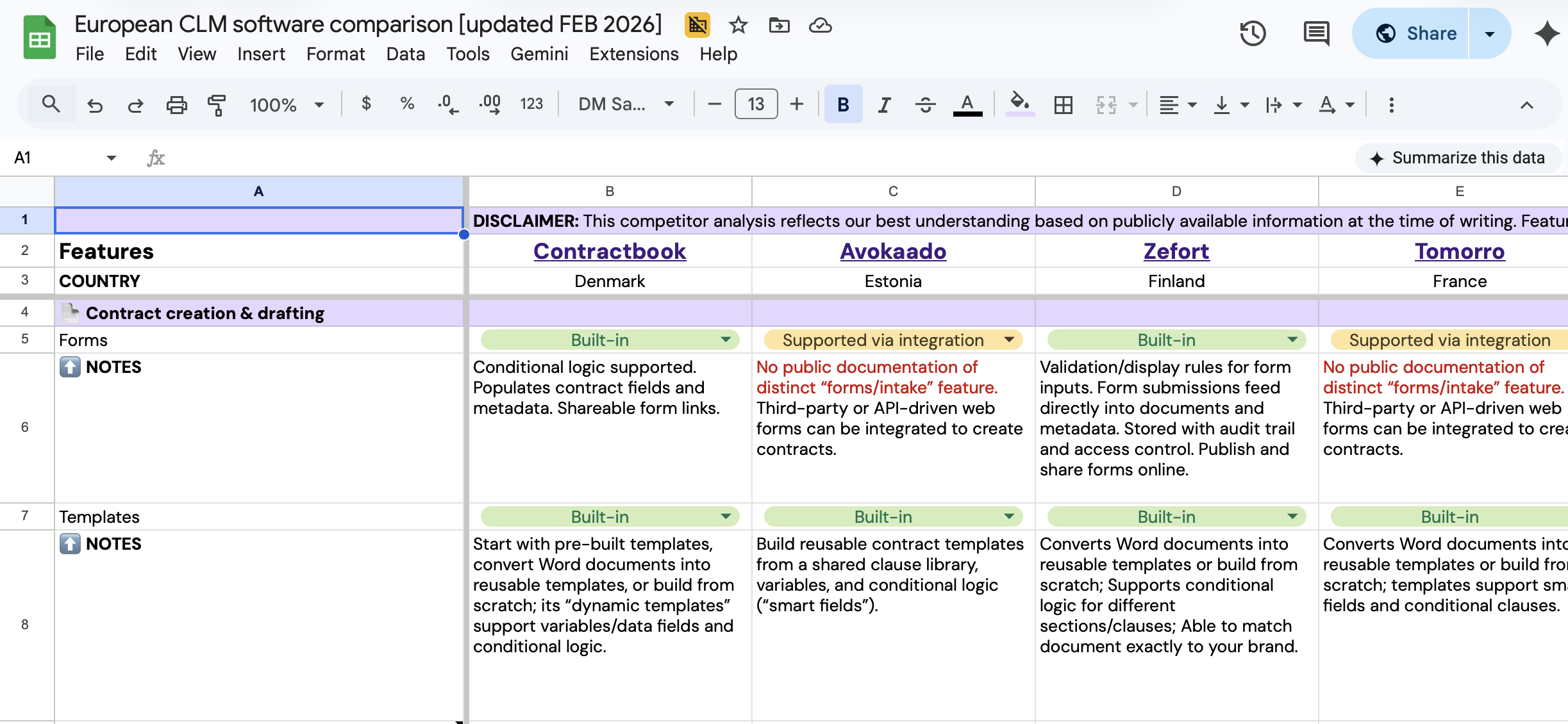
Get a comprehensive breakdown of the top CLM solutions in one spreadsheet.

Compare European CLM leaders
Get a comprehensive breakdown of the top CLM solutions in one spreadsheet.