
Rethinking legal growth: How modern CLM reshapes your legal team strategy
Legal teams are not just busier than before. The nature of their work has changed. Contract volumes are increasing across procurement, sales, partnerships, and compliance. At the same time, regulatory requirements are tightening, and business expectations are higher. Legal is expected to respond quickly, provide clarity, and support growth without slowing things down.
When contract workload starts to overwhelm the team, the default reaction is straightforward: hire another in-house lawyer or contract specialist. More hands, more capacity. On the surface, this seems logical.
But before opening a new headcount request, it is worth asking a more fundamental question: is the real bottleneck legal expertise, or is it the way contracts are managed?
The real cost of hiring versus investing in CLM software
A mid-level in-house legal hire in the Nordics typically costs between €100,000 and €180,000 per year when fully loaded with salary, benefits, taxes, and overhead. This does not include recruitment costs, onboarding time, or the internal effort required to integrate a new team member into existing processes.
Now consider how much of that person’s time would be spent on administrative contract work – searching for agreements, manually extracting key dates, tracking renewals in spreadsheets, and clarifying ownership.
Compared to the annual cost of a fully loaded in-house legal hire, a modern CLM platform is often a significantly smaller investment. Its impact is structural: manual tracking is replaced with automated metadata, searchable contracts, and built-in lifecycle alerts. In practice, organizations often find that a meaningful share of administrative contract work, sometimes in the range of 20 to 40 percent, can be streamlined or eliminated through structured automation.
Seen from this perspective, the question shifts. It is no longer “Can we afford software?” but rather “Are we using highly trained legal expertise for tasks that could be structured and automated?”
Why don’t more people fix broken contract processes
If contracts are scattered across shared drives, inboxes, and legacy systems, adding more people does not solve the structural issue. It simply increases the number of individuals navigating the same fragmented landscape.
Without centralized visibility, teams struggle to answer basic questions. How many active contracts do we have? Who owns them? Which agreements are up for renewal next quarter? What obligations are still open?
Missed renewals and untracked termination windows can have direct financial consequences. Many organizations have experienced situations where a single unnoticed auto-renewal would have covered the annual cost of a CLM system several times over.
Compliance risk also remains. If access rights are unclear or contract versions are inconsistent, legal exposure does not decrease simply because the inbox is shared among more people. Hiring into chaos tends to scale chaos.
How modern CLM becomes a capacity multiplier
A modern CLM platform changes the operating model. Instead of contracts being files stored somewhere, they become structured, searchable assets with clear ownership and lifecycle status.
Centralized storage creates a single source of truth. Automated metadata extraction identifies key fields such as parties, dates, and renewal terms. Built-in reminders ensure that termination windows and obligations are visible well in advance. Role-based access control strengthens governance and reduces unnecessary exposure.
The impact is practical and immediate. Legal teams spend less time searching, reminding, and clarifying. Business units receive faster responses, and reporting becomes easier, improving audit readiness and regulatory confidence.
This does not replace legal expertise – it amplifies it. When administrative friction decreases, legal professionals can focus on negotiation, risk assessment, and strategic advisory work that directly supports business growth.
Read next: How to choose a European contract management software: 5 things that matter
A smarter way to scale legal
There are situations where hiring is absolutely the right decision. If the organization is entering new jurisdictions, handling complex disputes, or expanding into heavily regulated markets, additional expertise may be essential.
However, if the core issue is lack of visibility, manual tracking, inconsistent access control, or unclear ownership, the bottleneck is structural rather than intellectual. In these cases, technology creates a more durable impact than headcount.
Modern legal growth is not about building a bigger team. It is about building a stronger legal function. By investing in structured contract management infrastructure, organizations enable their legal teams to operate with clarity, control, and confidence.
Before approving the next in-house hire to handle contract workload, it may be worth considering whether the greater return lies in reshaping how contracts are managed in the first place.
🔑 Key takeaways
- Growing contract volume does not automatically require growing headcount. First assess whether the bottleneck is expertise or inefficient contract processes.
- A fully loaded in-house legal hire represents a significant annual investment, while a modern CLM platform typically costs considerably less and addresses structural inefficiencies.
- Structured automation, centralized storage, and lifecycle alerts can meaningfully reduce routine administrative contract work and free up legal capacity.
- Adding people to fragmented systems scales complexity. Fixing visibility, ownership, and governance creates lasting impact.
- The goal is not a bigger legal team, but a stronger legal function with clarity, control, and the ability to support the business strategically.
FAQs
It depends on the root cause of the pressure. If your organization is dealing with increasingly complex legal matters, new jurisdictions, or disputes, additional legal expertise may be necessary. However, if the strain comes from administrative contract work, lack of visibility, missed renewals, or fragmented storage, a modern CLM platform can often create greater structural impact at a lower cost than adding headcount.
Results vary by organization, but many companies find that a meaningful share of routine administrative work can be reduced once contracts are centralized and structured. Automated metadata extraction, searchable repositories, and built-in renewal reminders eliminate much of the manual tracking previously done in spreadsheets and inboxes. In practice, it is reasonable to estimate that around 20 to 40 percent of administrative contract effort can be streamlined when processes are standardized and supported by technology.
Return on investment typically comes from multiple sources: time saved in contract search and reporting, reduced risk of missed renewals or unintended auto-renewals, improved compliance, and faster response times to business units. In many cases, preventing even a single costly auto-renewal or compliance issue can justify the investment. Over time, the structural efficiency and improved governance create ongoing value beyond the initial cost savings.
Compare European CLM leaders
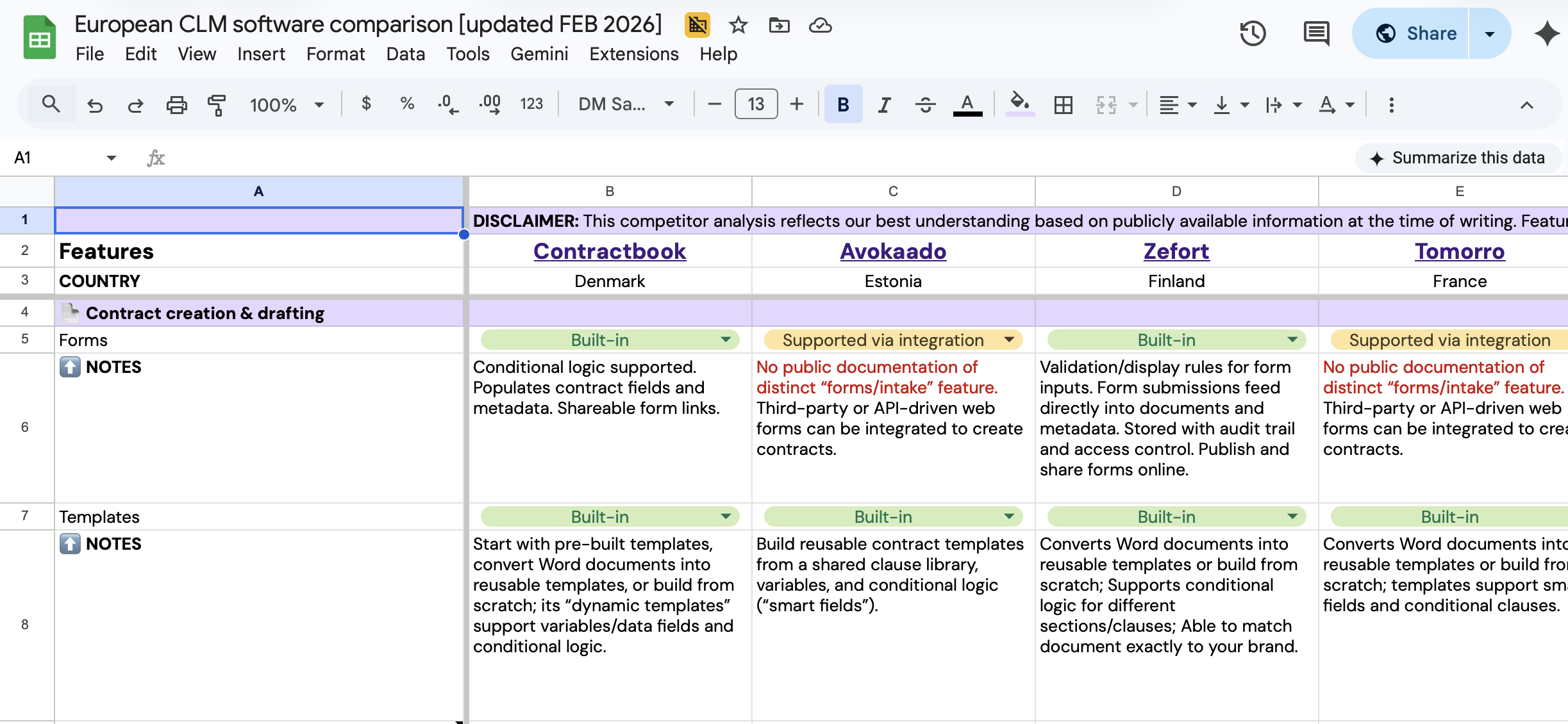
Get a comprehensive breakdown of the top CLM solutions in one spreadsheet.

Compare European CLM leaders
Get a comprehensive breakdown of the top CLM solutions in one spreadsheet.