What is contract automation? Benefits, features, and best practices
Contract automation is continuously changing how legal, procurement, and business teams manage agreements. Automating contract creation, review, approval, and tracking reduces manual work and risk. Understanding the technology, benefits, and best practices can set your organization up for scalable, compliant growth, especially where regulatory frameworks like DORA and NIS2 apply.
The article will explore:
- The key features of contract automation
- How automation boosts efficiency, reduces errors, and saves costs
- Relevant benefits for regulated and high-volume organizations
- Current best practices for contract management automation
What does contract automation do?
Contract automation applies software and technologies, including AI, workflows, and templates, to automate the full contract lifecycle. Instead of relying on manual emails, edits, or tracking spreadsheets, teams use purpose-built tools to standardize and speed up every step from initial drafting to renewal or expiry.
Key workflows supported include:
- Automated drafting: Predefined templates and clause libraries standardize contract generation, keep language consistent, and auto-fill party data for accuracy.
- Workflow routing: Automated approval paths with role-based permissions ensure only the right people review and approve each document.
- Electronic signatures: Integrated e-signature tools enable remote, secure contract execution without delays.
- Version control and audit trails: All revisions are tracked in a single repository, preventing outdated contracts or compliance gaps.
- Compliance and alerts: Automated checks confirm regulatory adherence, with reminders for key dates and automated obligation tracking.
- AI-driven capabilities: Smarter review tools highlight non-standard clauses, extract key data, and suggest edits based on risk or deviations.
- Integration and reporting: Connects to CRM, ERP, and business systems for seamless data flow, contract search, and status tracking.
These capabilities address real issues: missing deadlines, inconsistent terms, scattered documents, and lack of process transparency, all of which are common in manual workflows.
What are the main benefits?
The shift to automation goes beyond saving time. When implemented well, it changes how organizations control risk, collaborate internally, and scale their contracting processes.
- Faster contract cycles: Standardized templates, clause libraries, and approval workflows reduce back-and-forth and manual handoffs, keeping contracts moving in a more predictable way.
- Fewer errors: Standardized language, version control, and guided workflows help ensure contracts use approved clauses and follow internal policies, lowering the risk of omissions or inconsistencies.
- Lower costs: Reduced manual work, fewer errors, and shorter cycle times decrease administrative overhead, limit reliance on external counsel for routine contracts, and prevent costly mistakes or missed obligations.
- Improved risk management: Centralized contracts, approved clauses, and audit trails support consistent compliance, including regulatory frameworks such as DORA and NIS2.
- Better collaboration: Real-time status, centralized activity feeds, and search tools take the chaos out of email approvals, enabling fast, cross-department work.
- Data-driven decisions: Searchable contracts and structured metadata make it easier to identify obligations, renewals, and risk exposure.
- Scalability: Automation supports higher contract volumes without increasing headcount, and without sacrificing contract control.
Deloitte has found that organizations who standardize the contract management process potentially save upwards of 60% in legal and negotiation expenses related to contracts. By layering contract automation onto these standardized process, organizations can drive even greater efficiencies.
How AI and automation address real-world challenges
Manual contracting remains a bottleneck, especially across multi-national operations. Key problems include:
- Delays from siloed workflows and unclear approval channels
- Risk of outdated versions, missed deadlines, or non-compliance
- Inefficient use of legal resources for routine contract review
- Poor audit trails and documentation for due diligence or regulatory investigations
AI-enhanced automation addresses these challenges by enforcing playbooks, surfacing risk deviations, and maintaining complete documentation across the contract lifecycle. Centralized systems support quick retrieval and reporting during audits or investigations, which is key under frameworks like DORA or NIS2.
Automated metadata extraction and reporting create a reliable single source of truth, which is critical during audits, investigations, or compliance reviews under regulatory frameworks such as DORA and NIS2.
Best practices for contract management automation
Effective contract automation depends on process foundation and user engagement:
- Standardize templates and clauses: Keep a single source of approved contracts and clauses, updated for regulatory and business changes.
- Map workflows end-to-end: Define steps from request to renewal, including role-based permissions and automated alerts.
- Integrate with core business systems: Connect contract tech to CRM, ERP, or procurement tools so data flows automatically.
- Leverage AI: Use AI to extract key data, assess risk, and identify language deviations, refining contracts over time.
- Centralize and secure storage: Maintain all contracts in a searchable, permissioned repository for access, audits, and reporting.
- Train and monitor: Empower business and procurement teams for routine contracts, and use metrics such as cycle times, errors, and renewals to optimize.
- Pilot, then scale: Start with high-volume agreements, demonstrate value, then expand automation.
These steps streamline processes and make compliance, efficiency, and collaboration the default.
Read next: Contract management software reviews: how to look beyond ratings
🔑 Key takeaways
- Standardization drives major savings: Organizations that standardize contract management processes can reduce legal and negotiation expenses by up to 60%, creating a strong foundation for further optimization.
- Automation accelerates the entire contract lifecycle: From drafting and approvals to execution and renewals, automated workflows eliminate bottlenecks and significantly shorten contract cycle times.
- Risk and compliance become proactive, not reactive: Centralized repositories, audit trails, and AI-assisted clause review strengthen oversight and support regulatory requirements such as DORA and NIS2.
- AI enhances accuracy and visibility: Intelligent data extraction, deviation detection, and structured metadata turn contracts into searchable, actionable business assets.
- Scalability without added headcount: Contract automation enables organizations to handle higher volumes of agreements efficiently while maintaining control, consistency, and governance.
FAQs
Contract automation streamlines contract creation, review, approval, and tracking by using software, templates, and automated workflows. This reduces manual work, speeds up contract cycles, minimizes errors, and provides real-time visibility throughout the contract lifecycle.
Automation provides standardized workflows, real-time audit trails, and automated compliance checks. This helps organizations consistently meet regulatory requirements, monitor deadlines, and demonstrate adherence during audits or investigations.
AI can extract key contract data, highlight non-standard or risky clauses, suggest edits, and provide analytics for smarter contract reviews. This reduces manual review time and helps maintain contract standards.
Best practices include standardizing contract templates, mapping end-to-end workflows, integrating with core business systems, leveraging AI features, centralizing contract storage, training users, and piloting with high-volume contract types before broader rollout.
Key features include automated drafting with templates, workflow routing with role-based approvals, electronic signatures, version control, compliance checks, AI-driven data extraction, and integration with business systems for reporting and tracking.
Compare European CLM leaders
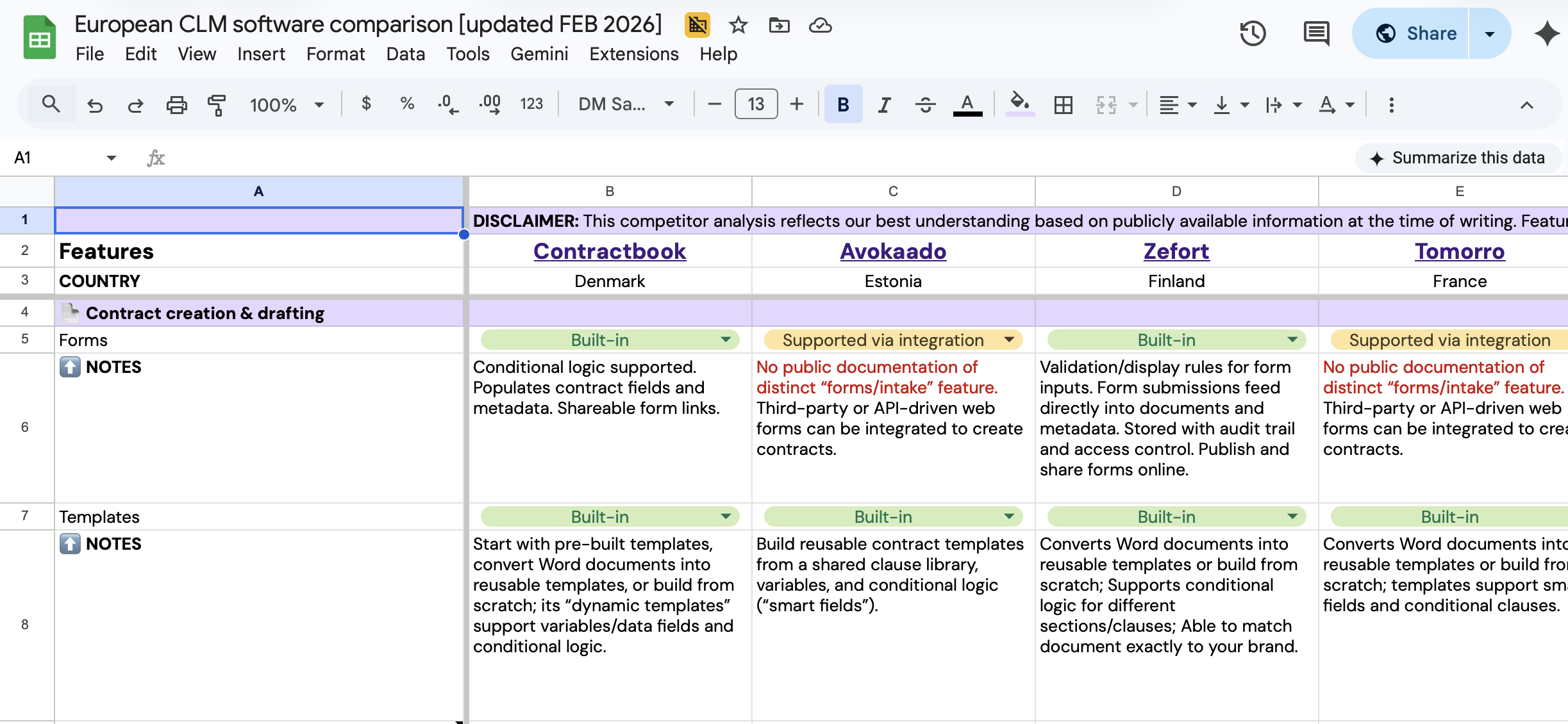
Get a comprehensive breakdown of the top CLM solutions in one spreadsheet.

Compare European CLM leaders
Get a comprehensive breakdown of the top CLM solutions in one spreadsheet.