
What is contract management? A comprehensive guide to today’s CLM
Contract lifecycle management has outgrown its old definition.
For years, CLM was explained through a simple model: pre-sign, sign, and post-sign. It was a useful framework for a time. It helped organizations understand that contract management is not just about drafting or storage, but about managing agreements across their full lifespan.
In 2026, that model no longer captures what contract management actually looks like.
Contracts are no longer created in just one place. They may start in a CRM, a procurement platform, a document automation tool, a self-service workflow, or an AI-assisted drafting environment. Signature is no longer a single isolated event, either. It sits inside a larger operating model that includes approvals, identity, auditability, and downstream automation. And after signing, the real work often only begins: you must track obligations, manage access rights, analyze contract data, and enforce compliance requirements.
At the same time, expectations towards CLM solutions have risen. Organizations no longer want a digital archive with reminders. They want searchable contract data, stronger governance, reliable integrations, and a secure foundation for automation and AI. More importantly, they want to turn contract data into actionable business data that can be used across the organization.
That is why it is time to rethink contract lifecycle management.
In this guide, we will examine what CLM traditionally meant, why that view is no longer sufficient, and what a current, AI-driven approach to contract lifecycle management should include today.
What is contract lifecycle management?
Contract lifecycle management (CLM) is the process of managing contracts throughout their entire lifecycle – from creation and negotiation to signing, storage, monitoring, and renewal. The goal of CLM is to ensure that contracts are created efficiently, executed securely, and managed to reduce risk, improve visibility, and support business operations.
In practice, contract lifecycle management includes activities such as drafting contracts, collecting approvals, signing agreements electronically, storing contracts in a secure repository, tracking key dates and obligations, and maintaining visibility into contract terms across the organization.
Historically, CLM was often explained through a three-stage model introduced earlier: pre-sign (drafting and negotiation), sign (execution), and post-sign (storage and management). This model helped organizations move away from manual processes and scattered contract storage toward more structured and digital workflows.
Today, however, the scope of contract lifecycle management is expanding. CLM systems must not only manage contract workflows but also structure contract data, enable advanced search and analytics, support governance and compliance requirements, and integrate with other systems such as CRM, procurement platforms, and identity providers.
As a result, contract lifecycle management is increasingly understood as the way organizations manage their contracts, maintain reliable contract data, and ensure agreements are accessible, secure, and actionable across the business.
Why the traditional CLM model no longer reflects reality
The three-stage model still describes parts of contract work. What it misses is the complexity of today’s operating environment.
Contract management today does not occur within a single closed workflow. It happens across systems, teams, and data layers.
A supplier agreement may begin in a procurement process. A legal team may use separate drafting tools, negotiation workflows, or clause libraries. Business users may initiate requests through forms. Some documents may be generated automatically. Others may be created or reviewed with AI support. Signature may occur within the CLM platform, via a dedicated e-signature tool, or through another integrated process.
That means the old linear model breaks down for a simple reason: contract management is no longer only about stages. They also need intelligence, governance, integration, and secure control over contract data regardless of where the contract originated.
This is the paradigm shift. CLM is no longer just a lifecycle workflow. It is a capability stack built around trusted contract data.
The new framework for contract lifecycle management
If the old CLM model focused on stages, the new one focuses on what the platform must enable.
That shift matters because contracts now live inside a broader legal and business ecosystem. The question is no longer only, “What happens before or after signing?” The better question is, “What capabilities do we need to manage contracts properly in a complex, connected, AI-enabled organization?”
Today’s CLM approach should support four core capability areas.
- Contract creation, signing, and managing
- Contract intelligence
- Governance and control
- Integrations capabilities
Together, these capabilities form the foundation of contract operations.
This is also why CLM should not be viewed merely as a workflow engine or a document archive. It should be understood as the operating layer that maintains the reliability, security, and usability of contract data across the business.
Contract lifecycle management in practice
Let’s take a closer look at what today’s contract lifecycle management looks like in practice, and how the Zefort AI CLM platform supports it.
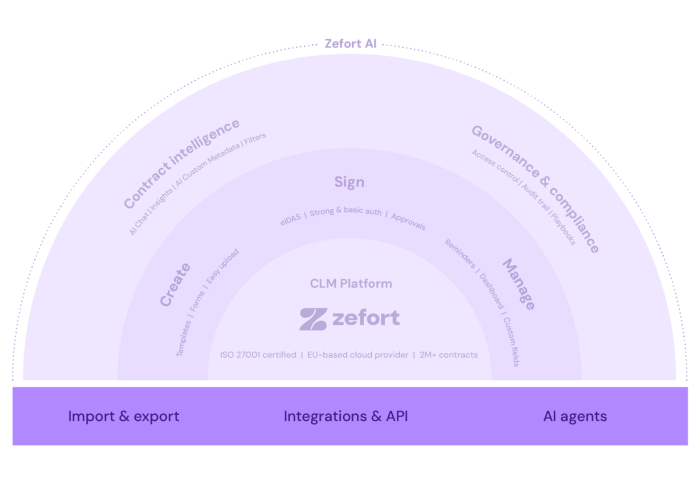
The model below illustrates the key layers of a strong CLM environment.
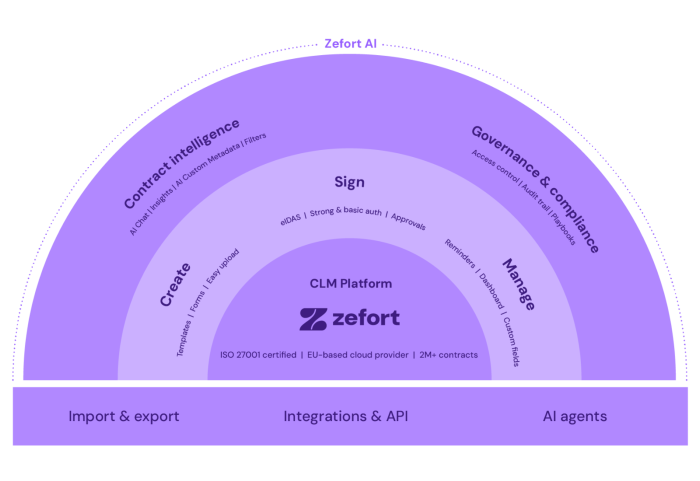
At the center is a secure platform that stores, structures, and governs contract data. Around this foundation are lifecycle capabilities that support the creation, signing, and management of agreements across the organization. On top of these operational capabilities sit intelligence and governance layers that help teams understand contract portfolios, maintain control, and meet growing compliance requirements. Finally, the platform connects to the broader business ecosystem through integrations, APIs, and automation.
Zefort’s AI-driven CLM platform is designed around this framework, providing organizations with a secure contract data foundation, along with lifecycle, intelligence, governance, and integration capabilities to manage contracts effectively in today’s technology environment.
1. System of Record – A core platform for managing contract data
At the center of contract management sits the core platform. This System of Record is the trusted environment where contract data is stored, structured, and governed.
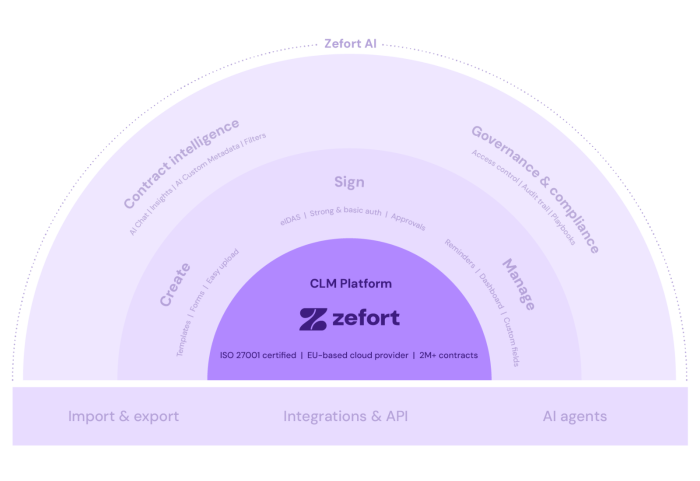
In practice, organizations need a system that acts as the master environment for their contract data. Contracts may originate in many places, such as procurement systems, CRM tools, document automation solutions, or external negotiations, but the organization still needs a designated platform where the authoritative version of contract information resides.
This need has become even clearer as the SaaS landscape has expanded. The rapid development of AI tools and specialized workflow solutions has created a growing ecosystem of applications involved in contract work. While these tools can improve individual tasks, they also increase fragmentation if there is no central system that brings the data together.
A useful comparison can be found in the CRM market. Sales organizations may use many tools for prospecting, communication, analytics, and automation, but the CRM platform remains the central system that unifies and manages customer data.
Contract management follows the same logic. A CLM platform must serve as the system of record for contract data while also providing the capabilities to manage agreements throughout their lifecycle.
Zefort is designed to serve exactly this role. The platform provides a secure, structured environment for storing, organizing, and governing contracts, while also supporting the broader capabilities required for contract operations.
2. Managing contracts across the entire contract lifecycle
Contracts are still managed across a lifecycle. Agreements are created, negotiated, executed, and managed over time.
What has changed is where these steps take place.
In many organizations, contracts no longer originate in a single system. A procurement agreement may begin in a sourcing workflow. A customer contract may start in a CRM process. HR agreements may be generated through internal tools. In other cases, contracts may enter the system through imports, external negotiations, or legacy migrations.
This means that a CLM platform must support a variety of contract entry points while maintaining control over the agreement lifecycle.
Once contracts are in the platform, organizations need structured ways to manage them throughout their lifespan. This includes organizing agreements, monitoring key dates and obligations, and maintaining visibility into the contract portfolio.
The contract repository, therefore, becomes much more than a storage location. It serves as the operational environment for managing contracts consistently across departments and use cases.
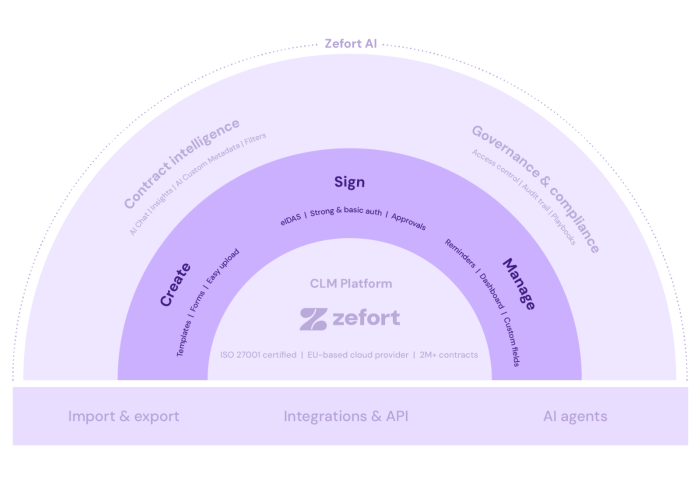
Zefort has been designed with this reality in mind. The platform supports the full lifecycle of contracts while allowing organizations to adapt workflows and processes to their own operational model. This flexibility enables effective contract management even in environments where agreements originate from multiple systems.
3. Contract intelligence, governance, and compliance in CLM
Once contract data is centralized and structured, organizations can begin to unlock significantly more value from it.
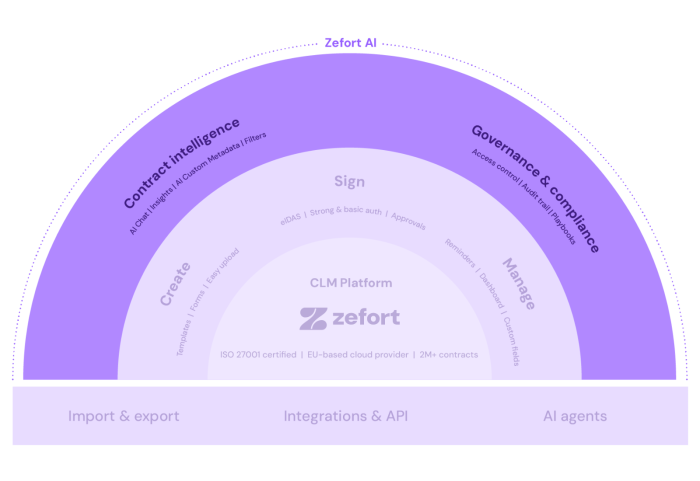
Contract intelligence plays a key role in this shift. Instead of treating contracts as static documents, today’s platforms can analyze and structure the information contained in agreements. AI capabilities can help index contract content, surface relevant information, and help users understand large contract portfolios more efficiently.
The value of AI in contract management depends directly on the quality of the underlying data. If contracts are fragmented, unstructured, or difficult to access, AI will produce inconsistent or unreliable results. When contract data is structured, searchable, and governed, AI can operate on it effectively, enabling more accurate insights, automation, and decision support.
This transforms contract repositories into searchable knowledge bases. Teams can explore contract portfolios, identify patterns, review key terms, and generate insights that support legal, procurement, and leadership decisions.
More importantly, this shift turns contracts into a usable data layer for the business.
When contract data is structured and accessible, it can be used beyond legal or procurement workflows. Organizations can connect contract data to risk management, supplier oversight, financial planning, and regulatory compliance processes. Instead of being stored as documents, contracts become a source of operational and strategic information.
At the same time, governance and compliance have become increasingly important aspects of contract management. These requirements have grown significantly in recent years as regulatory expectations around data protection, operational resilience, and supplier oversight have increased across many industries.
A CLM platform today must therefore support both intelligence and governance. It should help organizations understand their contract data while ensuring agreements are managed in a controlled, auditable environment.
Zefort’s platform is designed to support both dimensions. By combining structured contract data with advanced analytics and governance capabilities, organizations can manage contracts with greater visibility, control, and confidence.
4. Integrations, APIs and, AI agents in a CLM platform
No contract platform operates in isolation.
Contracts interact with many other systems across the organization, including procurement platforms, CRM environments, identity providers, financial systems, and document workflows. As a result, integration capabilities are a critical part of any CLM architecture.
A platform must be able to connect seamlessly with surrounding systems while still maintaining a reliable contract data foundation. This ensures that contract information can flow between tools without losing structure, ownership, or control.
Zefort supports this through a combination of native integrations, open APIs, and a flexible architecture designed for today’s enterprise environments. These capabilities allow organizations to connect contract management to the workflows and systems that already support their operations.
The rise of AI agents is further expanding the importance of these integration capabilities. AI-powered agents increasingly rely on structured and trustworthy data sources to automate tasks, monitor obligations, and generate insights.
As organizations adopt AI more broadly, contract data increasingly becomes part of retrieval-based workflows, where systems and agents access relevant contract information in real time.
This enables new use cases. For example, organizations can assess regulatory requirements, monitor compliance, or identify contractual risks by combining contract data with AI-driven analysis. These capabilities depend on having contract data in a structured and accessible format.
Zefort’s platform is designed with this future in mind. Through MCP readiness and its open architecture, the platform enables organizations to build AI agents that can securely and reliably interact with contract data. This enables contract intelligence integration not only within the CLM platform itself but also across the broader organization’s digital ecosystem.
Conclusion
Contract lifecycle management is still about managing agreements from creation to execution and beyond. That part has not changed.
What has changed is the environment in which contracts are created, negotiated, and used. Agreements now move across multiple systems, involve more stakeholders, and increasingly serve as sources of structured business data. At the same time, organizations face growing expectations around governance, compliance, and operational visibility.
Because of this, CLM cannot be understood simply as a linear workflow. Now, contract management requires a platform that brings together contract data, lifecycle operations, intelligence, governance, and integrations into a single, coherent environment.
This is the shift from a lifecycle model to a capability-driven platform.
Organizations that adopt this model are better positioned to manage contracts at scale, maintain control over sensitive information, and unlock more value from their contract data. Instead of being static documents stored in repositories, contracts become part of a structured, searchable information layer that supports decision-making across the business. This makes it possible to use contract data not only for management, but as a source of actionable business information that supports decisions, automation, and compliance across the organization.
Zefort’s AI-driven CLM platform is built around this principle. By combining a secure contract data foundation with lifecycle management, intelligence capabilities, governance controls, and open integrations, the platform helps organizations manage contracts in a way that reflects how contract operations actually work.
In a world where contract work is increasingly distributed and AI-powered tools are becoming part of everyday workflows, the organizations that succeed will be those that build their contract management on a reliable, well-governed data foundation.
➡️ Read next: 10 best contract management tools
🔑 Key takeaways
- Traditional contract lifecycle management (CLM) models based on pre-sign, sign, and post-sign no longer fully describe how contract management works.
- Contracts are now created, negotiated, and managed across multiple systems, including CRM platforms, procurement tools, document automation solutions, and AI-assisted workflows.
- CLM should be understood as a System of Record – a platform built around trusted contract data, not just a linear workflow.
- A contract management platform combines several capability layers: contract creation and signing, contract intelligence, governance and compliance, and integrations with other business systems.
- Contract data is increasingly treated as business data, enabling organizations to turn agreements into actionable insights, automation, and decision support.
- A secure contract data foundation enables organizations to search, analyze, and govern their contract portfolios more effectively.
- AI is increasing the value of structured contract data, making centralized and well-governed contract repositories even more important.
- Integrations, APIs, and automation capabilities allow contract management platforms to connect with the broader technology ecosystem of the organization.
- Zefort’s AI-powered CLM platform is designed around this contemporary framework, helping organizations manage contracts with better visibility, control, and intelligence.
FAQs
Contract lifecycle management (CLM) is the process of managing contracts throughout their entire lifecycle, from creation and negotiation to signing, storage, monitoring, and renewal. Contemporary CLM platforms help organizations manage contract data, track obligations, maintain governance, and gain visibility into their contract portfolios.
The traditional model assumes that contracts move through a single, linear workflow. In reality, contracts are now created and processed across multiple systems and teams. Today’s contract management requires capabilities for contract intelligence, governance, integrations, and secure control over contract data.
A contract system of record is the trusted platform where an organization stores and manages its contract data. Even if contracts originate in different systems, the system of record ensures that contract information remains structured, searchable, and governed in one secure environment.
AI can help organizations analyze contract content, extract key information, identify risks, and generate insights from large contract portfolios. However, AI works best when it operates on structured and well-governed contract data stored in a reliable CLM platform.
A CLM platform should provide a secure contract data foundation, support contract lifecycle operations, enable contract intelligence and analytics, offer strong governance and compliance controls, and integrate with the organization’s broader technology ecosystem through APIs and integrations.
AI contract management platform
Turn contracts into structured data and stay in control.