Why contract data is still invisible in most organizations (and why that’s risky)
Even in 2026, contract data remains hidden in many organizations, scattered across emails, shared drives, silos, and paper archives. When contracts are this hard to find, they might as well not exist from a business perspective because they can’t reliably inform decisions, operations, or risk management.
At the core of the problem is how contracts are treated: most organizations still see them as static documents rather than structured, usable data. As a result, critical information stays buried, making it difficult to search, analyze, or act on. This creates persistent barriers that turn contract data into something that is technically stored, but practically inaccessible.
This article will cover:
- The underlying reasons contract data becomes fragmented and hard to access
- The business and compliance risks caused by poor visibility
- Practical ways to improve contract data control and reduce exposure
The root problem: contracts as dark data
Scattered contracts are one problem. However, even when a contract is easy to find, the data inside it (obligations, pricing, renewals, SLAs) is rarely captured in a structured way that systems can query or monitor. As a result, contracts become dark data: information that technically exists but isn’t visible or usable in practice.
This lack of usable data is reflected in industry research. World Commerce & Contracting (WorldCC, 2025) reports that contract data is typically fragmented across dozens of systems, limiting visibility and decision-making, while nearly 90% of business users say contracts are difficult or impossible to understand. Similarly, Concord’s 2024 market report found that 100% of respondents identified the lack of real-time visibility into contracts as a major pain point.
The result is that leaders have documents, but not data. They can open a PDF, but they can’t answer questions like “How many suppliers have this data processing clause?” or “Which enterprise customers are on non-standard liability caps?” without significant manual effort or at all within a reasonable timeframe.
Why this persists:
- Fragmented storage and ownership: Sales, procurement, legal, finance, and local business units each keep their own copies and versions, with no single source of truth, which leads to duplication, inconsistency, and uncertainty about what is current.
- Basic repositories, not true data models: Many “contract repositories” are glorified folder trees that store files but don’t enforce a model for contract types, clauses, and relationships, so they can’t resolve ambiguities or surface consistent data.
- Manual, one-off extraction: Where data is captured, it’s often in spreadsheets maintained by one team, quickly going stale and diverging from the signed document.
- Post-signature blind spot: Investment and attention peak during negotiation, then drop sharply after signature, so obligations, SLAs, and renewals are left to email reminders and individual memory.
- Cultural framing: Contract work is viewed as legal administration, not as a source of operational and commercial insight, so there’s little pressure to industrialize data capture.
Why invisibility is risky
When contract data is invisible, risk doesn’t vanish. It just becomes harder to see until it turns into an incident, dispute, or regulatory finding.
Financial risk and revenue leakage
The same report from WorldCC in 2025 illustrated that ineffective contract management can erode ~8–9% of annual revenue, largely because entitlements and obligations aren’t tracked or enforced. Common failure modes include missed renewals, unapplied price increases, discounts that continue beyond their intended term, and services delivered without corresponding billing when scope changes aren’t reflected operationally. Poor visibility into these terms leads to misaligned pricing and billing, unenforced rights, and a steady leakage that accumulates across hundreds or thousands of agreements.
Compliance, regulatory, and legal exposure
When you don’t know which contracts contain certain clauses or obligations, you can’t reliably demonstrate compliance or react quickly when laws or standards change. This is especially acute in regulated sectors, where third‑party obligations, data processing terms, and audit rights must align with frameworks like GDPR, NIS2, or DORA for example; if you can’t identify which vendors or partners are on legacy terms, you’re exposed in an audit or incident. Inconsistent application of terms and untracked changes in regulations compound legal liabilities, increasing the likelihood of fines, disputes, or forced remediation under tight deadlines.
Operational drag and decision latency
Front-line teams often struggle to locate the contracts they need, leading to delays, repeated searches, and back-and-forth with legal to confirm terms. Without real-time visibility, leaders lack a clear view of key elements like termination rights, volume commitments, or liability positions. As a result, decisions are either slowed down by incomplete information or made with increased risk to maintain speed. Without a reliable single source of truth, planning, forecasting, and vendor or customer strategy become harder to execute with confidence.
Security and access risks
When contracts are scattered across personal inboxes, laptops, and unmanaged shared drives, access controls and audit trails are weak or non-existent. That increases the likelihood of unauthorized access to sensitive commercial terms, personal data, or security obligations, and makes incident investigations harder because you can’t easily see who had access to what and when.
How better contract data management prevents risk and leakage
Most companies don’t start by looking for “Contract Lifecycle Management (CLM).” They start by experiencing the symptoms.
They see:
- Deals delayed because no one can confirm the current standard terms or obligations with an existing customer.
- Renewals or notice periods missed because monitoring lives in someone’s calendar or a spreadsheet that wasn’t updated.
- Audit or regulator queries turning into firefighting projects to find “all contracts with X clause” under time pressure.
- CFOs asking simple questions (“How much revenue is at risk in the next 90 days?”) that require heroic manual work to answer.
These issues all point to the same root cause: contract data that isn’t accessible, structured, or actively managed.
CLM platforms address this by extracting, structuring, and continuously updating contract data so teams can quickly find and act on what matters. Instead of searching through documents, legal, procurement, and business teams can query contract data directly.
Automated tracking highlights obligations, flags risks, and alerts teams to upcoming deadlines, reducing both revenue leakage and compliance exposure while improving accountability.
A centralized, searchable repository further strengthens control by creating a single source of truth. Audits become faster and more reliable, accountability improves, and teams spend less time chasing information. Features like role-based access and audit trails help ensure compliance while protecting sensitive data.
Ultimately, moving from fragmented storage to structured contract data management shifts organizations from reactive firefighting to proactive control and helps to enable better decisions, stronger compliance, and more predictable outcomes.
Read next: What is contract management? A comprehensive guide to today’s CLM
🔑 Key takeaways
- Contracts are scattered across teams, systems, and formats with no single source of truth, leading to inconsistent versions and poor visibility.
- Even when contracts are stored more accessibly, the data inside them (e.g. obligations, pricing, clauses) is not structured or searchable, making it practically unusable.
- Lack of contract visibility drives revenue leakage (up to ~8–9%), increases compliance exposure, slows decision-making, and heightens security risks.
- Centralized, AI-driven contract data management enables timely access, better compliance, reduced revenue loss, and more informed decisions.
- Clear, accessible contract data shifts contract management from crisis response to strategic control, improving business outcomes.
FAQs
It refers to contract information that exists but isn’t structured or accessible for analysis, such as key terms buried in PDFs that systems can’t interpret or monitor.
Because it’s fragmented across teams (legal, sales, procurement, etc.), stored in different systems, and often managed manually without a standardized structure.
- Revenue leakage from missed renewals or unenforced terms
- Compliance failures and regulatory exposure
- Slower decision-making due to lack of reliable data
- Security risks from uncontrolled access to sensitive contracts
CLM platforms extract and structure contract data, making it searchable and trackable. They also automate monitoring (e.g. deadlines, obligations), reducing risk and manual work.
Compare European CLM leaders
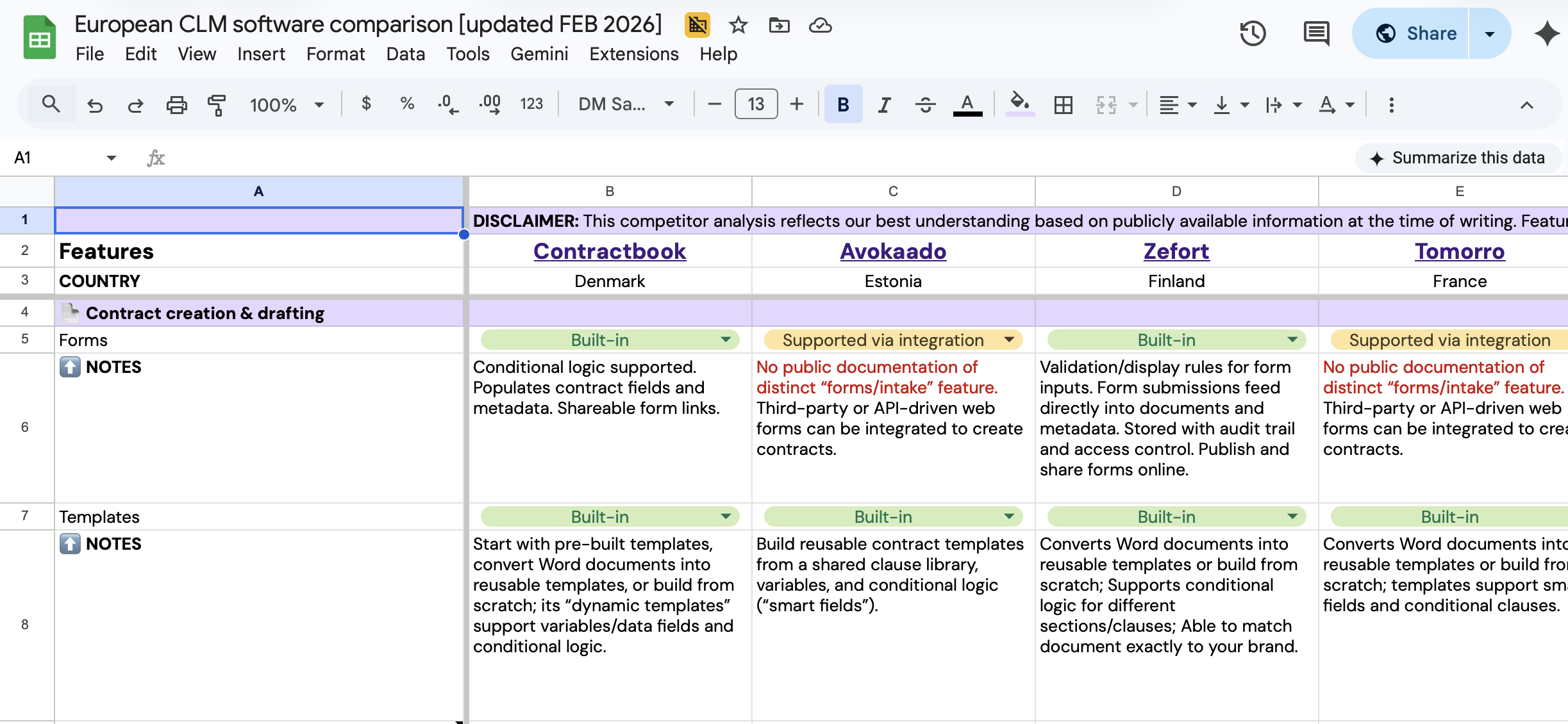
Get a comprehensive breakdown of the top CLM solutions in one spreadsheet.

Compare European CLM leaders
Get a comprehensive breakdown of the top CLM solutions in one spreadsheet.