Why highly regulated EU industries can’t afford spreadsheets for contracts anymore
Spreadsheets fall short for organizations in highly regulated EU industries. Manual tracking of contracts increases compliance risk, slows audits, and creates information silos. This article explains the operational, compliance, and financial cost of spreadsheet reliance, and shows how post-signature CLM platforms help business teams meet EU regulatory compliance requirements without legal bottlenecks.
The key points covered:
- The real business impact of spreadsheets for contract compliance management
- How post-signature CLM workflows address GDPR, eIDAS, and audit challenges
- Why business teams, not just legal, need ownership of contract obligations
- What industry data shows about risks and cost triggers
- Key steps to move from spreadsheets to audit-ready repositories
The spreadsheet problem in regulated contract management
Spreadsheets may seem like a quick fix for tracking renewals and obligations, but in regulated EU industries, they create serious gaps. These gaps widen as your contract portfolio grows, especially after signature. Spreadsheets do not deliver audit-ready trails or automated checks needed for contract compliance management.
These issues occur because:
- No immutable audit trail. Spreadsheets lack version controls required by rules such as eIDAS.
- Human error is constant. Manual entries increase missed renewals and factual mistakes.
- Lack of centralization. Contracts end up scattered across email, folders, and drives, making it hard to locate live versions.
- Inadequate access governance. No role-based permissions expose records to unwanted edits or leaks.
This becomes critical when organizations exceed hundreds of active contracts, face a regulatory audit, or undergo rapid growth and M&A. Bank, pharma, and energy sector firms see these issues most acutely due to strict EU regulatory compliance demands.
Quantifying the business and compliance impact
The numbers paint a clear picture of the risks and inefficiencies of managing EU-regulated contracts with spreadsheets and fragmented tools:
- 6–12% average contract value leakage is attributed to poor contract management, including missed renewals and unmanaged obligations. Centralized CLM systems with automated alerts significantly reduce this revenue loss.
- Over 68% of contract professionals search for completed contracts at least once a week, limiting time available for fulfilling complex obligations and ensuring compliance.
- 40% of organizations admit that it’s not clear who is in charge of contract-related tasks, increasing the risk of errors, missed deadlines, and inconsistent compliance practices.
- Organizations using automated contract management report 50–70% reduction in legal review time per contract and 80% faster data extraction, driven by AI-powered data extraction and standardized processes.
- GDPR enforcement actions regularly result in multi-million-euro fines since its inception, with poor documentation, lack of traceability, and weak contract controls frequently cited as contributing factors.
Every time a spreadsheet is used to track key contract obligations, business teams risk financial penalties, lost revenue, and failed audits.
How these problems appear in daily operations
At first, spreadsheets may seem like a perfectly adequate way to track contracts. They are familiar, fast to set up, and easy to share. But as time passes and contract volumes grow, small inconsistencies start to accumulate. Ownership becomes unclear, updates fall behind, and teams begin to rely on outdated or incomplete information.
Spreadsheet-driven workflows create daily friction:
- Contracts scatter across personal or shared folders, with no way to confirm document versions are current.
- Signed contracts remain stuck in emails, either possibly never reaching storage at all or being archived twice by accident.
- Renewal dates and obligations are managed manually, making them easy to miss or duplicate.
- Audits stall for days as teams hunt down fragmented files and rebuild data trails.
- Legal-designed CLM tools often neglect post-signature management, so business users still revert to spreadsheets for quick reviews.
For regulated industries, each gap translates into real compliance risk and higher costs.
How post-signature CLM addresses compliance and business risk
Post-signature CLM platforms help business and compliance teams move from fragmented manual tracking to controlled, audit-ready contract management. Key benefits include:
- Automatic archiving from e-signature platforms into a secure, indexed repository which ends the cycle of lost emails and folders.
- AI-driven metadata extraction for key dates, counterparties, and renewals, enabling instant searches and reporting.
- Immutable audit trails and access logs, meeting eIDAS and other regulatory demands for record integrity.
- Automated reminders and workflow triggers, so procurement and finance can act on obligations without legal team delays.
- Scalable business user access, with role-based controls, so teams own compliance together, instead of relying on a single gatekeeper.
This control is now required for true contract compliance management in regulated environments.
Read next: How financial institutions use CLM to meet compliance demands
🔑 Key takeaways
- Spreadsheets are not audit-ready tools. In regulated EU industries, they increase compliance risk, slow audits, and obscure accountability.
- The biggest risks emerge after signature, when contracts are tracked manually and obligations are owned by no one.
- Industry data shows clear financial impact: missed renewals, administrative drag, and preventable compliance exposure.
- Compliance is no longer just a legal responsibility: procurement, finance, and operations must have controlled access to contract obligations.
- Post-signature CLM platforms replace fragmented tracking with centralized repositories, immutable audit trails, and automated controls.
- Moving away from spreadsheets is not a tooling upgrade but rather a prerequisite for scalable, audit-ready contract compliance management.
FAQs
Spreadsheets lack critical features like version control, immutable audit trails, and access management. This leads to information silos, manual errors, and missed renewals. In regulated EU sectors, such gaps increase the risk of non-compliance with regulations like GDPR and eIDAS, often resulting in financial penalties and failed audits.
Manual spreadsheet tracking leads to an average 9% revenue loss from missed contract renewals and increases operational costs. Poor record-keeping can result in GDPR fines, which average €4.2M per incident in regulated sectors. Audits also become more expensive and time-consuming without centralized, searchable contract repositories.
Spreadsheets scatter contract data across emails, folders, and drives, making it difficult to locate current versions and track obligations. Manual processes cause delays during audits, increase the chance of duplicate or lost documents, and require teams to spend substantial time tracking renewals or searching for information.
These platforms centralize contracts in secure, indexed repositories and automate archiving straight from e-signature tools. AI-driven metadata extraction, automated reminders, audit trails, and role-based access controls help organizations track obligations, reduce errors, and maintain audit readiness to meet EU regulatory requirements.
Spreadsheets become problematic when an organization handles more than 500 active contracts, undergoes rapid growth, faces regulatory audits, or experiences mergers and acquisitions. At this scale, manual management often results in increased operational drag, compliance gaps, and higher audit costs.
Business teams such as procurement and finance, as well as compliance officers and legal operations, benefit from automated workflows and better visibility. Ownership of contract obligations no longer depends solely on the legal team, improving collaboration while reducing compliance risks.
Regulations like GDPR and eIDAS require immutable audit trails, traceability, and robust access governance that spreadsheets cannot provide. Automated platforms offer built-in compliance features—such as access logs and version control—that are now necessary to meet regulatory standards in EU industries.
Compare European CLM leaders
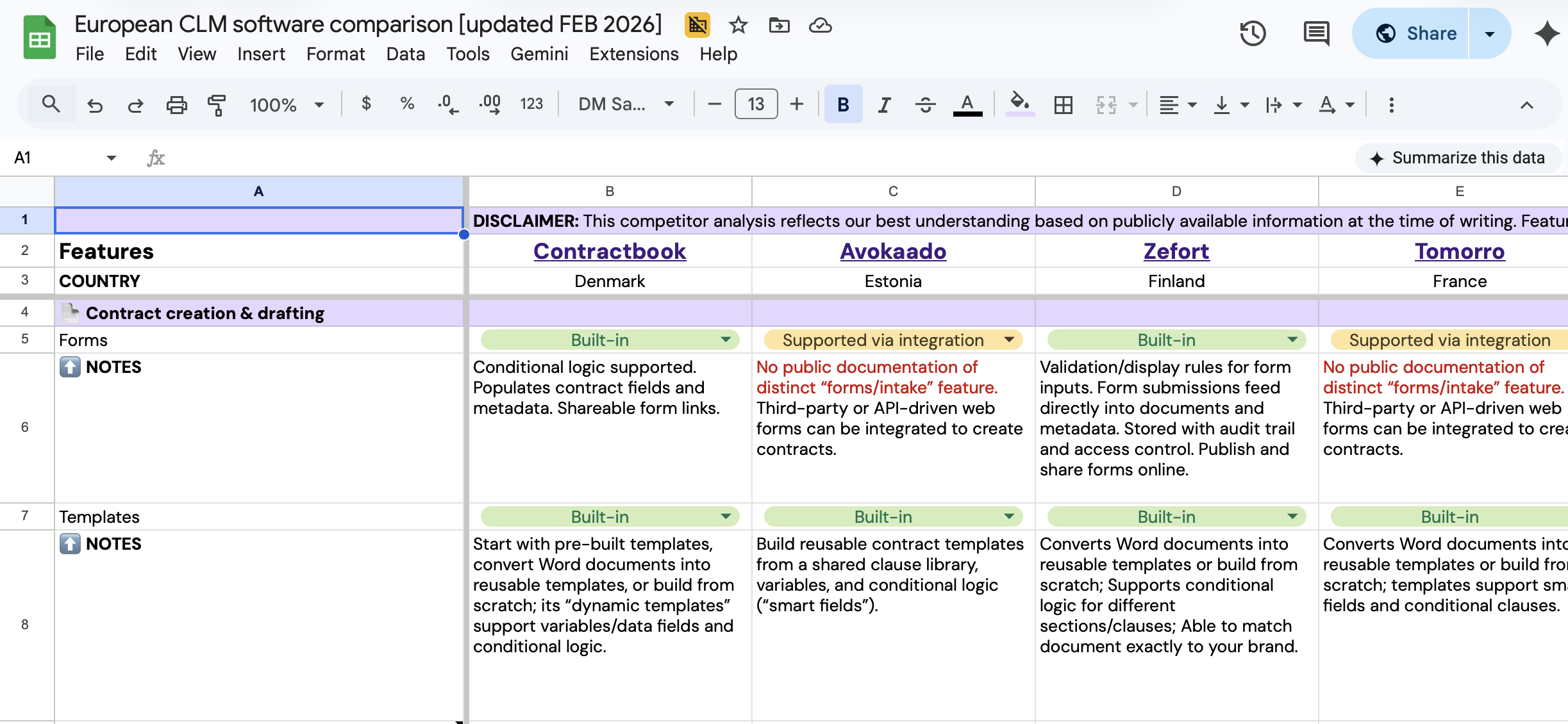
Get a comprehensive breakdown of the top CLM solutions in one spreadsheet.

Compare European CLM leaders
Get a comprehensive breakdown of the top CLM solutions in one spreadsheet.