
Where is your contract data stored? Mapping European CLM vendors (2026)
A recent “European Tech Map” soft launched on LinkedIn received a fair bit of traction for a simple reason: it surfaced hundreds of legitimate European alternatives in categories many people assumed were “US‑dominated,” and the most common reaction was essentially “I had no idea this existed.”
That exact dynamic shows up in Contract Lifecycle Management (CLM) platforms. Procurement teams often shortlist the same few vendors, typically non-European, despite a maturing European technology ecosystem.
According to the Atomico’s latest State of European Tech report, Europe’s tech sector now approaches a combined public and private value of almost $4 trillion, or about €3.68 trillion, in 2025. That represents a fourfold increase in roughly ten years. Many categories appear dominated by non-European vendors simply because the European alternatives remain less visible.
This article maps the European CLM landscape through three lenses: CLM vendors headquartered in Europe, platforms that process core service data exclusively within the EU/EEA or other “adequate” jurisdictions, and platforms that run on European‑owned cloud infrastructure. For procurement, legal, and security teams, these distinctions matter.
What you’ll learn in this article:
- Which CLM vendors are headquartered in Europe
- Why data residency and cross-border transfer rules affect CLM procurement
- Which vendors publicly document EU/EEA‑based processing for core service data
- Which vendors publicly document European vs non‑European cloud providers
- How to verify and challenge data‑location claims when selecting a CLM platform
Map of European-based CLM companies
Several CLM platforms originate in Europe. They serve organizations across industries including SaaS, financial services, manufacturing, and the public sector.
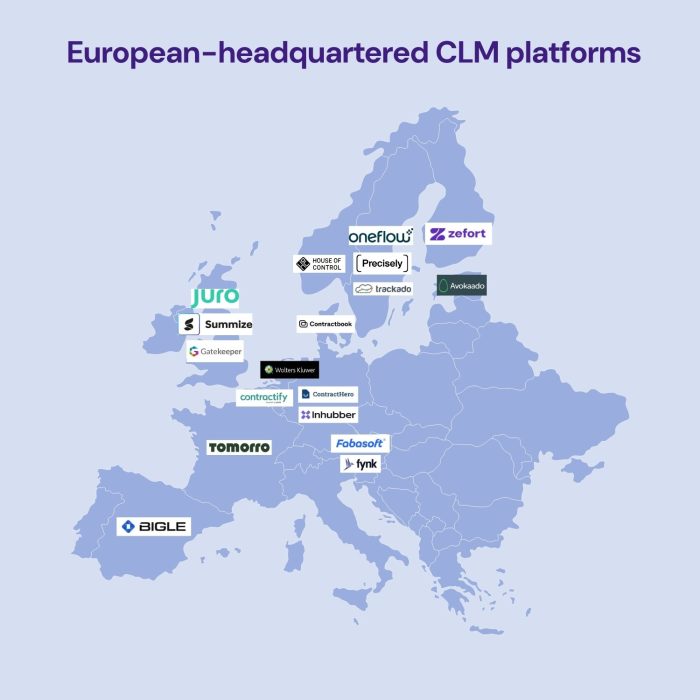
Based on publicly available company information as of March 2026, the following CLM vendors are headquartered in Europe:
| Country | CLM vendor |
|---|---|
| Austria | Fabasoft, fynk |
| Belgium | Contractify |
| Denmark | Contractbook |
| Estonia | Avokaado |
| Finland | Zefort |
| Germany | ContractHero, Inhubber |
| France | Tomorro |
| Netherlands | Legisway (Wolters Kluwer) |
| Norway | House of Control |
| Spain | Bigle Legal |
| Sweden | Oneflow, Precisely Contracts, Trackado |
| UK | Gatekeeper, Juro, Summize |
This list focuses on platforms that market themselves primarily as CLMs and is not a comprehensive census of every European CLM product.
Why buyers care: procurement, sovereignty, and cross-border transfer risk
CLM platforms store some of the most sensitive operational information inside an organization. Contracts frequently contain:
- Pricing and discount structures
- Liability limits and indemnities
- Renewal, termination, and auto‑renewal conditions
- Critical vendor and partner relationships
- Personal data inside agreements and metadata
Because of this, CLM tools often become part of broader data residency, international transfers, and digital sovereignty discussions.
GDPR and international data transfers
The EU General Data Protection Regulation (GDPR) restricts transfers of personal data outside the EU/EEA in Chapter V (Articles 44–49).
Organizations commonly rely on mechanisms such as:
- Adequacy decisions for certain third countries
- Standard Contractual Clauses (SCCs)
- Binding Corporate Rules (BCRs)
After the Schrems II ruling by the Court of Justice of the European Union in 2020 (Case C-311/18), regulators increased scrutiny of certain EU to US data transfers. The ruling prompted many organizations to review where their software vendors store and process data.
Digital sovereignty and regulatory pressure
European regulators increasingly discuss digital sovereignty, especially for sensitive sectors.
Regulations, such as DORA (Digital Operational Resilience Act) and NIS2 (Network and Information Security Directive), require stronger oversight of ICT providers and supply chains. This includes understanding where data is processed and which subprocessors are involved.
For regulated industries, these details are not optional. Procurement teams must document them during vendor assessments.
Separately, European regulators have also highlighted a practical sovereignty concern: even if data is physically stored in Europe, providers subject to third-country legal jurisdictions may face compelled access risks in certain scenarios, an argument that shows up frequently in “sovereign cloud” debates.
That context matters because it changes what “good enough” looks like:
- Baseline: GDPR‑compliant transfer mechanisms and contractual safeguards (e.g., SCCs) plus EU data residency with major cloud providers.
- Higher assurance: EU‑hosted data regions with documented EU/EEA (or adequate‑country) processing for core service data and clear subprocessor disclosures.
- Sovereignty-focused: Platforms that run on infrastructure owned and operated by European providers and avoid reliance on third‑country legal jurisdictions altogether.
Most CLM platforms meet the first requirement. Far fewer meet the third.
Map of CLM tools with Europe-based data processing
Many vendors publish data residency statements claiming “EU hosting,” but fewer offer Europe-only data processing across all core functions. This is where the list shrinks because vendors either:
- In a few cases, don’t publish clear data location statements, or
- Use subprocessors/data flows that involve non‑European processing for specific functions, or
- Offer region choices only at certain tiers, by contract, or via optional configurations.
What qualifies as “core service data”
Core service data in CLM platforms refers to the primary business-critical information that enables the core contract workflow functions. For example:
| Category | Examples | Why it’s “core” |
|---|---|---|
| Contract content | Full contract text, signed PDFs, amendments, exhibits/annexes | The actual agreements being managed |
| Contract metadata | Parties/counterparties, effective dates, expiry/renewal dates, values, contract type, status | Enables repository search, alerts, reporting |
| Obligation data | Milestones, KPIs, service levels (SLAs), payment schedules, delivery requirements | Drives performance monitoring and compliance |
| Approval records | Workflow history, approver names, timestamps, decision rationale | Creates the audit trail for governance |
Who made the “Europe-based processing” cut (and why)
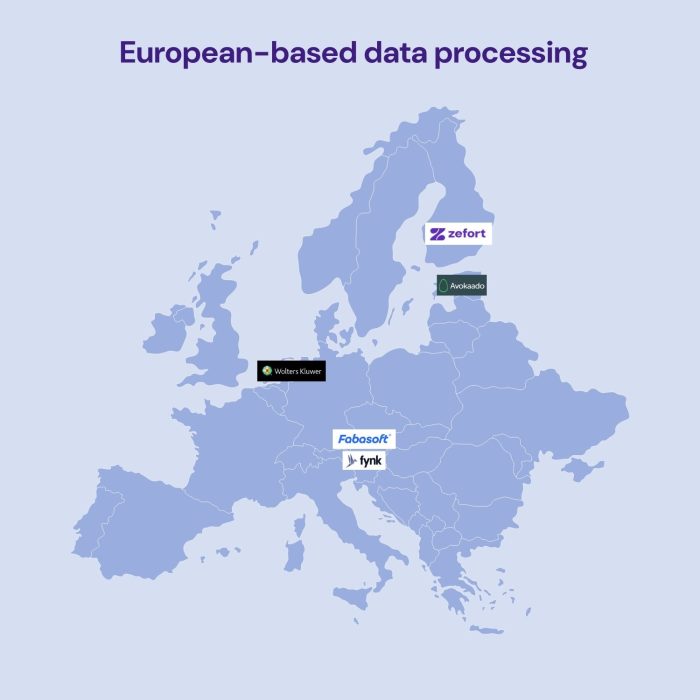
In the map below, inclusion in the “Europe‑based processing” group is based on vendor documentation (security pages, trust centers, DPAs, product docs) that, as of March 2026, explicitly describes processing of core service data within the EU/EEA or in jurisdictions with EU adequacy decisions, and does not list third‑country locations for that data.
A few limitations should be noted:
- Vendors may operate customer-specific deployments, regional configurations, or enterprise-contract exceptions not visible in public documentation.
- Optional product features (such as AI analysis, integrations, or notification services) may introduce subprocessors that customers can disable.
- Subprocessor lists sometimes describe potential processing locations, not necessarily the locations used for every customer.
As a result, this article reflects verifiable public documentation, not private contractual arrangements or undocumented configurations.
| Vendor | HQ country | Key evidence supporting EU-only processing | Sources |
|---|---|---|---|
| Avokaado | Estonia | Trust Center publishes a subprocessor list with processing locations, allowing verification that subprocessors operate within EU/EEA regions. Platform materials also state the service is hosted in the EU with no third-country transfers. | Subprocessors |
| Fabasoft | Austria | Privacy and cloud documentation state that data processing takes place exclusively in Germany, Austria, and Switzerland. Switzerland is an EU-adequate jurisdiction and Fabasoft cloud infrastructure operates in these regions. | Privacy statement |
| fynk | Austria | Documentation states that core service data is processed and stored within the EEA, with contract data permanently stored in AWS data centers in Germany and backups in other EEA locations. | Subprocessors; Help article |
| Legisway (Wolters Kluwer) | Netherlands | Essentials DPA includes a subprocessor table with EU data localization (Italy, Germany, Ireland, France, Netherlands) and UK processing for a specific indexing service (UK is EU-adequate). No US processing locations are listed in the DPA table. | DPA (Essentials); DPA (Enterprise) |
| Zefort | Finland | Privacy policy states Zefort does not process or transfer personal data outside the EU/EEA, and security documentation lists EU/EEA infrastructure providers and processing locations with a public subprocessor table. | Privacy policy; Security page |
Who didn’t make the “Europe-based processing” cut (and why)
The vendors below do not fit the EU/adequate‑only processing category for core service data (using the same public‑documentation standard as above).
| Vendor | Country | Key reason | Source |
|---|---|---|---|
| Bigle Legal | Spain | EU hosting stated, but no public subprocessor list or processing locations disclosed | Security page |
| Contractbook | Denmark | Signed PDFs processed via Twilio (US) during e-sign delivery | Subprocessors |
| ContractHero | Germany | File storage via Dropbox (US), collaboration via Google Workspace (US), and infrastructure via AWS (US) processing core contract data | Trust center |
| Contractify | Belgium | AI contract analysis via OpenAI (US), email delivery via SendGrid (US), and error monitoring via Sentry (US) processing operational contract data | Legal page |
| Gatekeeper | UK | AWS data hosting (US regions listed), AI processing via OpenAI (US), and group company Gatekeeper US LLC processes “all applications data” | DPA |
| House of Control | Norway | EU hosting stated, but some services distribute operational data across EU and US regions | Subprocessors |
| Inhubber | Germany | Frankfurt hosting stated, but no public subprocessor list or processing locations disclosed | Security page |
| Juro | United Kingdom | Email delivery and tracking via Twilio (US) processing contract data | Privacy policy |
| Oneflow | Sweden | Email delivery via Postmark (US) and AI services via OpenAI (US) processing contract workflow data | Security page |
| Precisely Contracts | Sweden | Default e-signature workflow stores copies of signed documents in the US during signing | Help article |
| Summize | United Kingdom | EU hosting stated, but no public subprocessor list or processing locations. | Security page |
| Tomorro | France | Email delivery via SendGrid (US), support via Intercom (US), analytics via Segment (US), and data warehousing via Snowflake (US) processing workflow data | Security page; Privacy policy |
| Trackado | Sweden | Customer support via Intercom (US) and email/2FA delivery via Twilio (US) processing contract notification data | DPA |
A practical takeaway for buyers
If Europe-based processing is a hard requirement, you can’t rely on assumptions like “European company = European processing” (or “EU data residency” marketing language without detail). What you actually want, procurement-wise, is typically:
- Clear statement of data storage and processing locations,
- Current subprocessor list (with data locations),
- Coherent explanation of when international transfers may occur (e.g., email/SMS delivery, error monitoring, AI features, e-sign integrations).
That last point matters because GDPR’s international transfer rules are triggered by certain cross-border disclosures, and many organizations prefer architectures and vendors that minimize transfer complexity, especially post‑Schrems II scrutiny.
Map of CLM tools with Europe-based cloud provider
With geopolitics tightening, many companies are updating their vendor policies: it’s not only where data sits, but also whose cloud it runs on. US-headquartered hyperscalers can create perceived jurisdictional risk (even when data stays in Europe), so some procurement teams prefer European-owned infrastructure.
Vendors using Europe-based cloud infrastructure
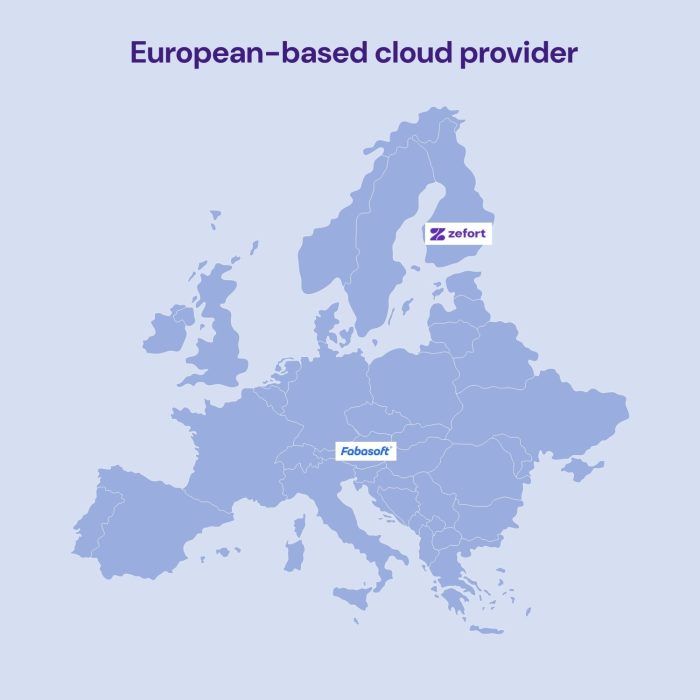
The following vendors publicly state that core application infrastructure runs on European cloud providers, based on vendor documentation available as of March 2026.
| Vendor | Country | Primary Hosting Provider | Status |
|---|---|---|---|
| Fabasoft | Austria | Fabasoft Cloud | European |
| Zefort | Finland | Hetzner + Scaleway | European |
Fabasoft runs its platform on Fabasoft Cloud, a proprietary infrastructure platform operated within European jurisdictions.
Zefort hosts its platform on Hetzner (Germany) and Scaleway (France), both European cloud providers with data centers located in the EU. A temporary exception applies: until 31 March 2026, Zefort maintains an EU-hosted backup system on AWS (Stockholm region).
For buyers with sovereignty or jurisdictional requirements, these architectures can simplify vendor risk assessments because they reduce reliance on non-European hyperscale infrastructure providers.
Vendors using non-European cloud providers
The majority of CLM platforms rely on global hyperscale cloud providers such as Amazon Web Services (AWS), Google Cloud, or Microsoft Azure.
These providers operate extensive EU data center regions and are widely used across the SaaS industry. However, they are headquartered in the United States and therefore may fall under non-European legal jurisdictions.
Based on publicly available documentation, the following CLM platforms rely primarily on mixed or non-European cloud providers:
| Vendor | Country | Primary Hosting Provider | Status |
|---|---|---|---|
| fynk | Austria | AWS | Non-European |
| Contractify | Belgium | DigitalOcean, AWS, Google Cloud | Non-European |
| Contractbook | Denmark | Google Cloud, Microsoft Azure | Non-European |
| Avokaado | Estonia | Google Cloud | Non-European |
| ContractHero | Germany | Microsoft Azure | Non-European |
| Inhubber | Germany | AWS, DigitalOcean | Non-European |
| Tomorro | France | AWS | Non-European |
| Legisway | Netherlands | AWS, Microsoft Azure, Claranet | Mixed |
| House of Control | Norway | AWS | Non-European |
| Oneflow | Sweden | AWS | Non-European |
| Precisely Contracts | Sweden | AWS / Google Cloud | Non-European |
| Trackado | Sweden | Microsoft Azure | Non-European |
| Gatekeeper | UK | Google Cloud | Non-European |
| Juro | UK | AWS, MongoDB, Google Cloud, Microsoft Azure | Non-European |
Vendors with unclear infrastructure documentation
For a small number of vendors, publicly available documentation does not clearly identify the underlying infrastructure provider.
| Vendor | Country | Primary Hosting Provider | Status |
|---|---|---|---|
| Bigle Legal | Spain | Not publicly documented | Unknown |
| Summize | UK | Not publicly documented | Unknown |
When infrastructure details are not clearly documented, procurement teams need to request clarification during vendor due diligence.
How procurement teams should evaluate CLM data location claims
Data residency language varies significantly across vendors. Marketing statements alone rarely provide enough clarity for compliance reviews of core service data (contract content, signed PDFs, metadata, obligations, approvals).
Procurement teams should verify:
Storage and processing locations
Ask vendors to document where contract content, signed PDFs, and metadata reside:
- Primary hosting location for contract repository
- Backup locations for signed agreements
- Disaster recovery regions for approval records and obligation data
Subprocessors and data flows
Many CLM platforms use subprocessors that touch core service data during routine operations:
- E-signature services → signed PDFs
- AI analysis → contract text/metadata
- Email notifications → contract status updates
- Search/indexing → contract content
Request: Detailed subprocessor list with jurisdictions for each core workflow.
A well-documented architecture simplifies procurement and reduces the time spent on legal and security reviews.
🔑 Key takeaways
- Europe has a growing ecosystem of CLM vendors across the Nordics, Baltics, France, and the UK.
- Data residency has become a central procurement factor due to GDPR, Schrems II scrutiny, and regulations such as DORA and NIS2.
- A vendor being headquartered in Europe does not guarantee Europe-only data processing.
- Procurement teams increasingly evaluate not only where data is stored, but also which cloud infrastructure providers are used.
- Based on publicly available documentation, only two CLM platforms in this analysis, Fabasoft and Zefort, appear to run their primary infrastructure on European-owned cloud providers.
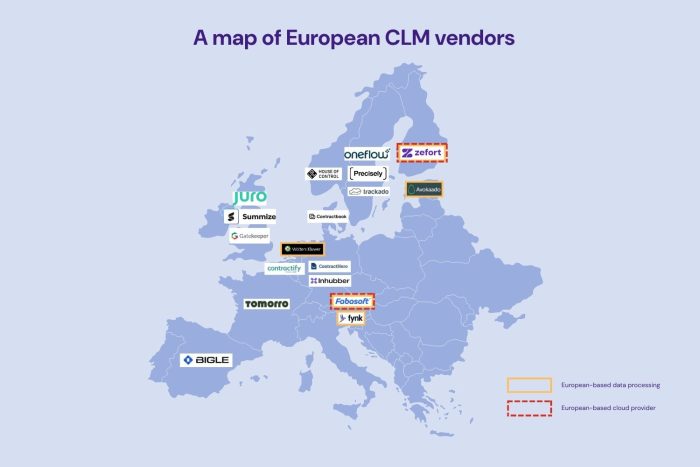
If you’re a founder and your CLM belongs on this list/map, send your company details to us so buyers can actually discover you because Europe doesn’t have a CLM quality gap, it has a visibility gap.
Correction (March 2026):
Following clarification from fynk, this article has been updated to reflect that the vendor processes core service data within the EU region. As a result, fynk has been added to the map of CLM providers with European data processing.
FAQs
Europe has a diverse group of Contract Lifecycle Management (CLM) vendors spread across the Nordics, Baltics, Central Europe, and the UK. Based on publicly available information as of March 2026, at least 18 CLM platforms are headquartered in Europe, including companies in Finland, Sweden, Denmark, Germany, France, the Netherlands, and other countries.
CLM systems store highly sensitive business information, including pricing terms, vendor relationships, personal data, and legal obligations. Because of this, organizations must ensure the platform complies with regulations such as GDPR. Data residency and processing locations determine whether personal data is transferred outside the EU/EEA and whether additional safeguards like Standard Contractual Clauses (SCCs) are required.
Core service data refers to the critical information used to run the contract workflow, including contract documents, metadata (such as dates and counterparties), obligation data, and approval records.
No. Some vendors host data in European data centers but still use subprocessors or services that process certain data in other jurisdictions, such as the United States. Buyers should review subprocessor lists and data flow documentation.
Procurement teams should request documentation on storage and processing locations, review the vendor’s subprocessor list and jurisdictions, and clarify when international transfers may occur (for example through AI features, email notifications, or e-signature integrations).
Compare European CLM leaders
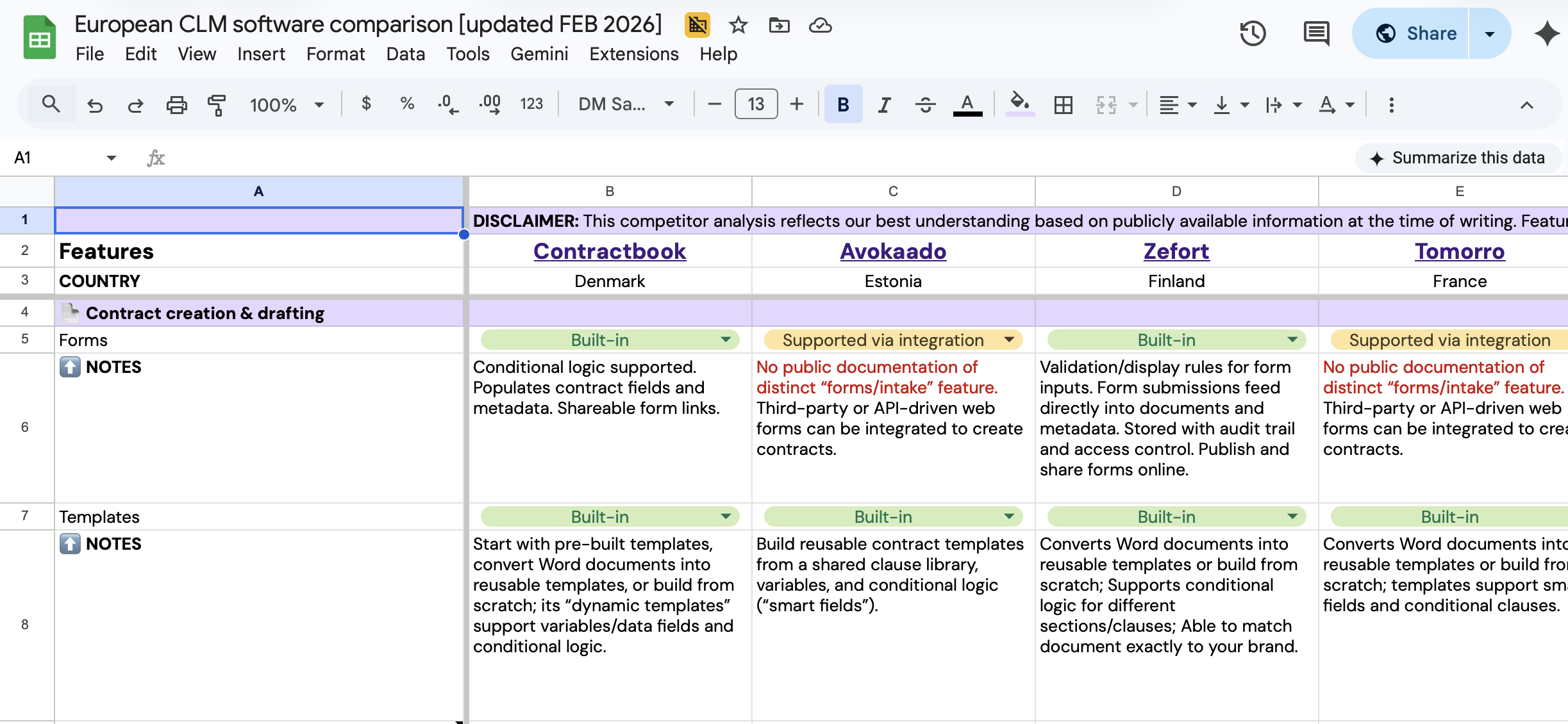
Get a comprehensive breakdown of the top CLM solutions in one spreadsheet.

Compare European CLM leaders
Get a comprehensive breakdown of the top CLM solutions in one spreadsheet.