Growing companies, big contract volumes: how a contract playbook enables scale without raising headcount
Growth almost always brings more contracts. What rarely scales at the same pace is the way those contracts are managed once they are active. Unchecked, this can lead to missed obligations, audit failures, and revenue loss, especially if cross-functional teams still rely solely on emails and/or spreadsheets.
This article examines why manual contract management fails as teams scale, the operational and financial risks that surface once contracts are in motion, and how contract playbooks, when operationalized through automation, enable organizations to manage larger contract volumes without increasing headcount.
Why scaling teams outgrow manual contract management
As businesses expand, particularly through rapid growth or acquisitions, contract volumes often jump from hundreds to thousands. Manual processes, like shared drives or spreadsheet trackers, buckle under this weight. Contracts turn into invisible liabilities scattered across different systems.
A key issue is the lack of scalable operational ownership after signing. Legal, procurement, finance, compliance, and ops all need active oversight, but simply outsourcing to legal or patching with ad-hoc trackers fails fast.
As contract volumes exceed 1,000, administrative work increases and visibility declines. Teams can try to compensate by adding headcount. Yet adding headcount isn’t a viable fix either. In a 2023 Juro survey, 75% of in-house legal teams reported a freeze in legal headcount, despite business growth projections of up to, or even exceeding, 2× that year. The result is more contracts, more risk, and the same constrained resources, exposing the limits of manual contract management.
Real-world risks and losses from poor oversight controls
Gaps in post-signature controls translate into direct business losses:
- Revenue leakage: Missed renewals and penalties on average account for 8.6% loss of contract value.
- Compliance risk: Poor tracking leads to disputes, and fines for data or vendor lapses (not considered serious infringements) can typically range from €1 million to €10 million or 2% of total global annual turnover, whichever is higher.
- Time sunk: 2–4 hours per contract per year, which amounts to about 3–5 full-time roles per 10,000 contracts.
- Audit failures: Audit prep breaks down fast when agreements aren’t centrally accessible. WorldCC’s 2023 benchmark found only 15% of organizations have a repository of signed contracts, making it far harder to produce evidence quickly and consistently under audit.
At 5,000 contracts, the cost for admin and audit prep could top €5 million annually. Manual tracking simply does not scale without proportional increases in headcount.
The foundational elements of a scalable contract playbook
An effective contract playbook translates legal and operational policy into clear, repeatable rules that can be applied consistently across the organization. To support scale, it must go beyond templates and define how contracts are owned, monitored, and acted on after signing.
- Clear ownership and accountability.
Without explicit ownership, responsibility defaults to no one. Each contract type has defined owners across teams. Legal sets guardrails, while procurement, finance, compliance, and operations own renewals, obligations, and performance within their remit. - Standardized rules and thresholds.
Outline what is acceptable, what requires escalation, and where exceptions are allowed. Approval limits, renewal windows, risk categories, and escalation paths should be clearly defined to ensure consistent decisions as contract volume grows. - Defined post-signature workflows.
Specify how contracts are managed day to day: how renewals are handled, how obligations are tracked, how amendments are logged, and how exceptions are reviewed. This removes reliance on individual knowledge and informal processes. - Centralized documentation and visibility.
All contracts, amendments, and supporting materials should be stored in a single system of record. Visibility into key terms, dates, and obligations is essential for cross-functional teams to act confidently without searching across tools. - Audit and compliance readiness.
Documentation standards, version control, and access logs are embedded into workflows, ensuring defensible audit trails and reducing regulatory risk. - Automation and system integration. To scale, playbooks must be operationalized through technology. Automated reminders, metadata extraction, ownership assignment, and reporting ensure playbook rules are consistently applied without increasing manual effort.
Together, these elements turn a contract playbook from a static reference into an operational framework that enables teams to manage contracts reliably, maintain compliance, and scale without adding friction or risk.
How an automated contract playbook enables operational scalability across departments
A contract playbook introduces scalable, automated rules for ownership, renewal alerts, and documentation, removing reliance on memory or scattered effort. Each department owns its piece: procurement tracks vendor SLAs, finance monitors rebates, and compliance ensures regulatory readiness.
- Centralized storage with AI metadata extracts key dates, clauses, and obligations, providing instant visibility even at 10,000+ contracts.
- Automated reminders and ownership assignment ensure contract actions are not missed, distributing accountability without legal being a bottleneck.
- Audit-ready trails, including full version history and access logs, meet SOX, GDPR, and ISO 37301 compliance requirements.
Compared to legal process outsourcing, which grows costs as contract loads rise, automation reduces manual effort and what once might have required 20 people working for a week can be completed by one employee in the same time.
🔑 Key takeaways
- Headcount cannot absorb contract growth. Legal teams face hiring freezes even as businesses scale, increasing risk without increasing capacity.
- Ownership, not legal review, is a key scaling bottleneck. Contracts require clear, cross-functional ownership after signing to remain controlled at scale.
- A contract playbook must be operational, not static. To support scale, playbooks must define ownership, rules, workflows, and escalation paths that apply consistently after contracts are signed.
- Automation turns contract management into infrastructure. When playbooks are embedded into automated workflows, through centralized storage, metadata extraction, reminders, and audit trails, organizations can manage thousands of contracts without adding headcount.
FAQs
Manual tools like spreadsheets, shared drives, and email rely on individual knowledge and fragmented processes. As contract volumes grow, visibility declines, administrative work increases, and critical obligations are more easily missed.
Headcount does not scale linearly with contract growth. Many legal teams face hiring freezes even as businesses expand, making it impractical to manage increasing contract volumes through additional staff alone.
Gaps in oversight lead to revenue leakage from missed renewals, compliance violations, audit failures, and significant time lost to manual administration and evidence gathering.
A contract playbook defines standardized rules, ownership, workflows, and escalation paths for managing contracts after signing. When applied consistently, it enables teams to handle larger volumes without relying on individual knowledge.
Automation operationalizes the contract playbook through centralized storage, metadata extraction, reminders, ownership assignment, and audit trails, reducing manual effort while improving visibility, accountability, and compliance.
Compare European CLM leaders
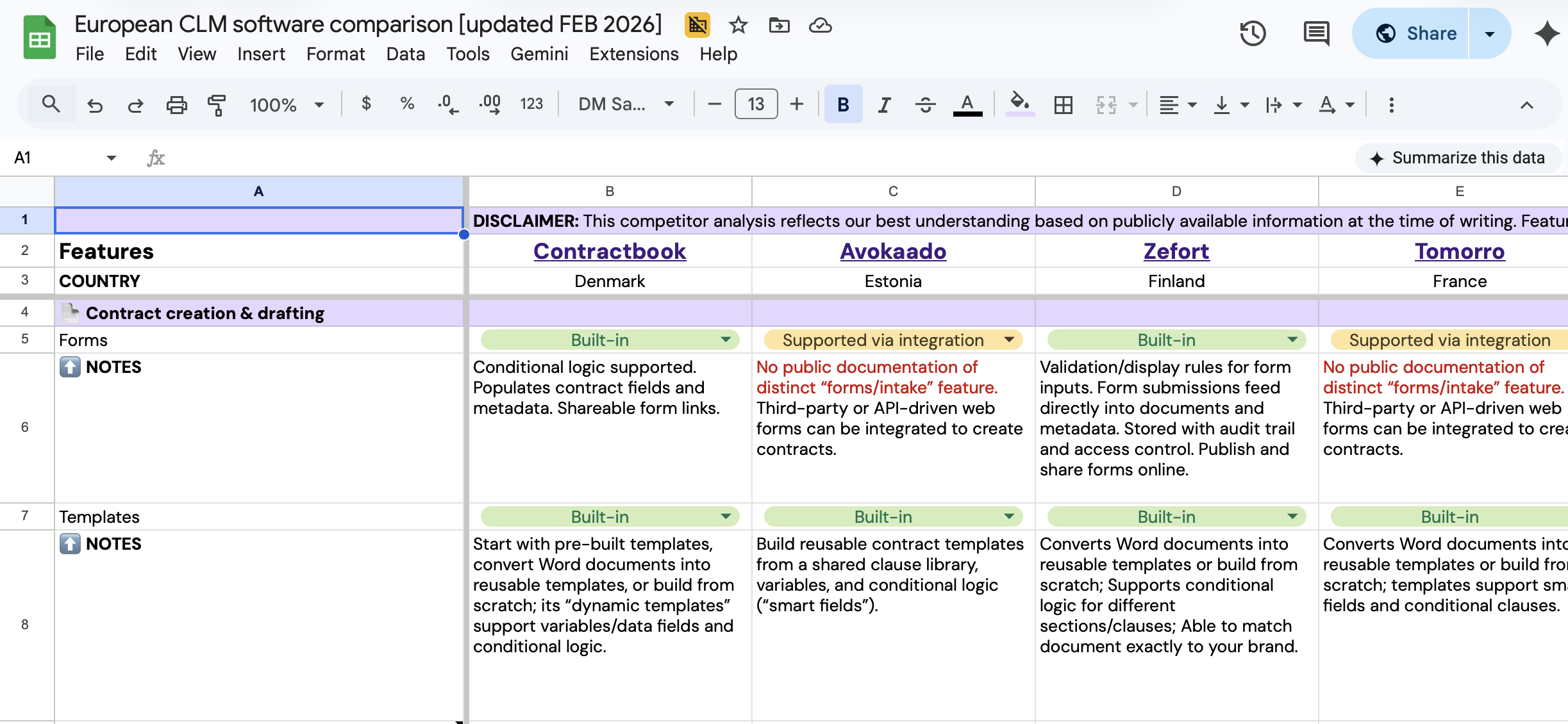
Get a comprehensive breakdown of the top CLM solutions in one spreadsheet.

Compare European CLM leaders
Get a comprehensive breakdown of the top CLM solutions in one spreadsheet.