
The ROI of contract lifecycle management software: how to build a business case
Contract lifecycle management (CLM) software can help you manage contracts with less effort, lower risk, and better visibility. The ROI is real, but only if the business case is grounded in how contract work actually gets done. You need a clear understanding of current costs, realistic efficiency targets, and a comparison of these gains against CLM’s total cost of ownership.
In a recent conversation with a prospect, a colleague walked through a concrete example based on everyday contract work. They focused on things like manual data entry, setting up reminders, reviewing contracts, and handling renewals. For each task, they estimated how much time it takes today and what that time is worth over a year if parts of the work are automated.
This article breaks that process down:
- How to quantify your company’s current contract management costs
- Which CLM ROI drivers matter most in day-to-day work
- How to build a simple, credible financial model
- Industry-specific ROI considerations
- Key qualitative benefits that don’t always show up in spreadsheets
Understanding CLM’s value proposition
CLM is about managing the entire contract lifecycle, not just storing documents. That includes creation, review, approvals, renewals, and ongoing obligations.
Modern CLM platforms connect contracts with the systems you already use, like CRM, ERP, procurement, and finance. This keeps contract data consistent and usable across teams instead of locked away in folders or inboxes.
The value of CLM comes down to three measurable areas: time savings, risk reduction, and productivity gains. Together, they form the basis of a realistic ROI model for contract automation.
Quantifying current-state costs
Before you can show ROI, you need a clear baseline. That means understanding where time and money are currently being lost.
Start by looking at:
- Manual effort costs: Time spent on data entry, reminders, follow-ups, and basic checks
- Missed actions loss: Renewals that slip by, obligations that aren’t tracked, or contracts that aren’t acted on in time
- Administrative overhead: Hours spent on data entry, document search, and tracking approvals
This baseline gives you something concrete to compare against once a CLM platform is in place.
Primary ROI drivers
CLM ROI comes from improving how contracts are handled every day. The biggest gains usually show up in efficiency, control, and visibility.
Time savings
Contract automation reduces manual work across the contract lifecycle.
- Contract creation: Templates and workflows reduce repetitive setup and manual data entry
- Review acceleration: Automation reduces review cycles and manual bottlenecks.
- Operational efficiency: Teams repurpose time spent on administration to higher-value work.
In my colleague’s example, automated metadata handling could potentially reduce manual effort by around 10 minutes per contract. Across 3,000 contracts per year, that translates into roughly 500 hours saved. Assuming the average salary is 20€ per hour, this equals about 10,000€ in annual savings.
In addition, automated reporting and trigger-based notifications reduce manual report creation and follow-ups by approximately 10 hours per month. This equals 120 hours per year, or 2,400€ in annual savings.
Risk reduction
Risk reduction is driven by improved control over renewals and contractual obligations:
- Fewer errors and disputes: templates and standardized workflows minimize renegotiation events
- Renewal management: AI-driven renewal tracking and automated action assignment help prevent missed renewals.
WorldCC found average contract value erosion at 8.6%. Consistent tracking and obligation management directly protect against this loss.
Per my colleague’s example, avoiding just one missed renewal per year, valued at approximately 10,000€, generates 10,000€ in direct annual benefit.
These figures exclude potential savings from avoided compliance breaches or regulatory penalties, which can significantly increase total ROI.
Increased revenue
Contract automation ROI also shows in accelerated deal closures and improved commercial terms:
- Faster execution: Shortened cycles bring revenue forward.
- Better terms: Access to historical contract metrics can yields negotiation leverage.
- Payment accuracy: Monitoring contract commitments and invoice details unlocks rebates and prevents penalties.
If you prefer to not rely on aggressive revenue uplift assumptions, a conservative business case could focus on measurable productivity improvements. For example, AI-assisted contract analysis could potentially reduce review time by approximately 15 minutes per contract. For 500 contracts reviewed annually, this equals 125 hours saved per year. Again at 20€ per hour, this produces 3,750€ in annual productivity gains.
Building the financial model
A CLM financial model compares current inefficiencies with future-state benefits to calculate ROI.
1. Calculate current-state costs
Identify existing inefficiencies across legal, procurement, and compliance teams, including:
- Manual task hours × hourly rates
- Missed renewals or unmanaged obligations
- Compliance penalties per year
- Lost revenue and administrative overhead
2. Determine future-state total cost of ownership (TCO)
Account for:
- CLM license fees
- Implementation and integration costs
- Training and change management investments
- Ongoing support and maintenance fees
Subtract time saved, productivity gains, and revenue protected to estimate new annual costs.
3. Quantify benefits
Apply this formula:
Time saved + Risk reduction + Revenue increase = Total annual benefits
An example calculation (excluding risk reduction):
- 10,000€ — contract creation and metadata automation
- 2,400€ — reporting and reminder
- 10,000€ — avoided missed renewal
- 3,750€ — faster contract review
Total annual quantified benefit: €43,750
This represents a conservative baseline and excludes harder-to-quantify benefits such as avoided disputes, audit readiness, and compliance risk reduction.
4. Calculate ROI
Use the standard ROI formula:
ROI = (Total Annual Benefits − Annual TCO) / Annual TCO × 100%
If annual CLM TCO is €25,000:
-
€43,750 − €25,000) / €25,000 × 100% = 75% ROI in year one
This approach produces a credible, CFO-friendly ROI model grounded in operational reality.
Industry-specific considerations
It may seem obvious but it important to note that CLM ROI varies by industry. Healthcare and finance, governed by DORA, NIS2, and strict operational rules, can often see higher returns due to reduced compliance exposure and strict audit trails.
Qualitative benefits
Not every benefit is (or needs to be) quantifiable. CLM can also deliver:
- Higher legal and compliance team morale by reducing monotonous work
- Improved reporting and analytics for decision-makers
- Faster contract turnaround for customers and partners
- Stronger alignment across departments
Measuring and tracking ROI
After implementation, keep tracking the metrics that matter:
- Contract cycle time
- Renewal and closure rates
- Compliance and value leakage incidents
- Workload reductions
Explore next: How to choose the right CLM for your organization
🔑 Key takeaways
- CLM ROI only works when it’s grounded in real work. A credible business case starts with everyday contract tasks like data entry, reviews, reminders, and renewals.
- The biggest ROI drivers are time savings, risk reduction, and productivity gains. These areas consistently show measurable impact across legal, procurement, and compliance teams.
- Small time savings add up at scale. Even modest reductions, like minutes saved per contract or hours saved per month, can translate into meaningful annual savings when applied across hundreds or thousands of contracts.
- You don’t need aggressive revenue assumptions to prove ROI. Conservative models based on time savings and productivity improvements can still deliver a strong return.
- ROI should be tracked over time, not calculated once. Metrics like cycle time, renewal rates, and workload changes help validate and refine the business case after implementation.
FAQs
Start by understanding how your contracts are handled in your company currently. Look at time spent on manual tasks, missed renewals, reporting effort, and review cycles. This current-state baseline is the foundation for any credible ROI calculation.
The most common drivers are time savings from automation, reduced risk through better renewal and obligation tracking, and productivity gains from faster reviews and better visibility.
No. Efficiency improvements and risk reduction can often be sufficient enough to build a credible CLM business case.
The examples are based on a real, practical scenario and use conservative assumptions. Actual results will vary depending on contract volume, processes, and team structure, but the approach is designed to be realistic and easy to adapt.
Track metrics such as contract cycle time, renewal rates, workload changes, and missed obligations. Measuring these over time helps validate the original business case and identify further improvement opportunities.
Compare European CLM leaders
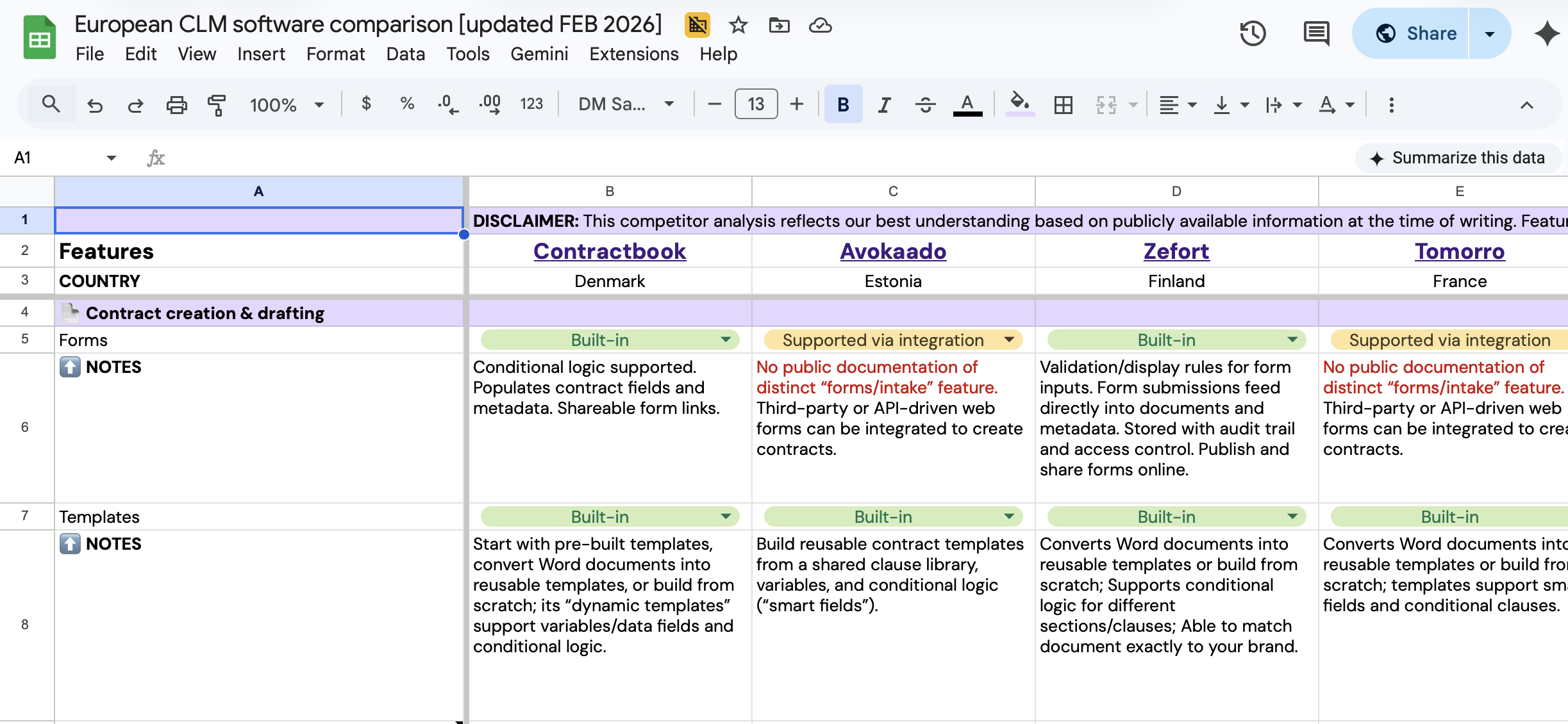
Get a comprehensive breakdown of the top CLM solutions in one spreadsheet.

Compare European CLM leaders
Get a comprehensive breakdown of the top CLM solutions in one spreadsheet.